
Choosing a Plagiarism Tool
“Best” no longer means “biggest repository”. For higher education, the winning choice delivers semantic similarity (paraphrase detection across languages), clear and auditable reports, controlled access to student submissions, institutional controlled sharing options with other institutions, privacy -first governance, and value across procurement and day to- -day workflows. On that basis, WISEflow Originality consistently offers strong “bang for the bucks” and has been chosen via public tender on combined functionality and price.
Best in-class means the best evidence, workflow and governance. Not just the biggest index.

THE 6 CRITERIA THAT SHOULD DRIVE YOUR DECISION CHOOSING A PLAGIARISM TOOL
Below, each criterion explains what to prioritise and what to verify. Then you’ll find a concise comparison: WISEflow Originality vs “others”.
- 1) Price & value (total cost of ownership)
- 2) Semantic similarity & paraphrasing detection
- 3) Sources that actually matter: student submissions first
- 4) Report clarity: ease of understanding matches
- 5) Data privacy & sharing options
- 6) AI detection: a necessary reality check?
Why it matters
- Licence costs vary widely, and assessor time is expensive. Context switching between systems additionally adds hidden costs to the offered licence cost.
- Evidence of value in recent and comparable tenders is stronger than list-price claims.
What to verify
- Clear licence model and transparent scope. Look out for offered functionality priced at add-on costs.
- Demonstrated value in recent (not just historic) public procurement or independent selections in your own region.
- Integration possibilities that reduce manual steps and assessor context switching.
WISEflow Originality
- Selected via many recent public tenders on functionality + price — value substantiated by procurement outcomes.
- In-app reporting inside WISEflow and clear usability minimises context switching and reduces operational overheads.
Other vendors
- Significant price variation is common, where basic functionality like semantic search, source adding etc. is priced as additional add-ons. Also significant variation in integration options, and none other than WISEflow Originality offers reporting as an overlay in the marking tool of the assessment platform.
Why it matters
- The most frequent misconduct is students copying students, often paraphrased or AI-washed and often within the same or similar institution. Detection must go beyond string matching to detect such conduct.
What to verify
- Combined semantic and string-b-ased matching
- Semantic similarity cross language for paraphrase detection
- Transparent presentation of paraphrased matches and with source detection
- Non-linear comparison, to avoid second student is the only one detected.
WISEflow Originality
- LLM-assisted- semantic similarity plus classical matching across 50+ languages; report rendered directly in the marking UI and two-way detection, so both copier and copied student is detected for comparison.
Others
- Semantic depth and cross -language coverage vary, as many do not offer real semantic search but just offer translation of text to do another string match against. Some tools just do simple string matches and thus do not catch paraphrasing or washed submissions.
Why it matters
- Most actionable matches come from student submissions, especially within the same licence or related institutions using the same language(s) because that is where students most often copy from each other.
- By contrast, students very rarely copy directly from research articles or books; a huge publisher corpus is thus less decisive than access to the relevant student paper- pool.
- Additional local web-resources, like subject matter archives or portal, should be possible to point out and added to the search.
What to verify
- Licence level- indexing of all your own submissions.
- Configurable sharing groups (e.g., local, national or regional) to compare against similar cohorts and languages.
- The ability to add ad hoc- institutional sources and harvest relevant web domains, not just a sprawling web crawl.
WISEflow Originality
- Indexes the institution’s own submissions; offers optional sharing groups (e.g., local, national, regional) so you can compare against the most relevant student work and oversee who you share with. WISEflow Originality also supports targeted web harvesting; and mirrors deletions / withdrawals to keep the index aligned with exam policy.
Others
- Access to all student submissions vary and some only search web sources and limited student cohorts. No one other than WISEflow Originality offer any institutional specific sharing model with control of own data sharing. Some highlights the offering of large external and publisher databases for their search – often as add-ons at additional cost but fail to inform of the limited detection rate from such sources.
Why it matters
- A dense or opaque report with hard-to-understand percentage scores burns assessor time and undermines decisions (what does 67% match mean?)
- Clear categorisation and inline overlays shorten the path from “possible issue” to “sound judgment”.
What to verify
- Intuitive match strength- categories (e.g., exact / strong / potential).
- Inline annotations, filtering and source context for easy overview.
- Possibility to exclude sources manually and to see matches excluded by the search.
- The ability to read the report without leaving the marking tool.
WISEflow Originality
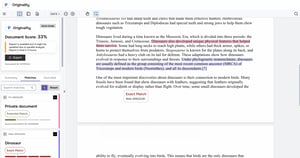
- Functions in WISEflow as an overlay (otherwise as an independent interactive report) with match -strength categories and side panel evidence, an audit- r-eady, explainable view for assessors, and with possibility to exclude matches and see manual and system excluded matches as well.
Others
- User interfaces range from basic to complex and many still require switching windows or tools to complete a full review. None offers matches in categories (exact, strong etc.) instead of percentages and very few list excluded sources by system.
Why it matters
- Originality checking uses student work. Institutions need control over where data is stored, who can see and access it, how long it is retained, and what gets shared (and with whom).
- Sharing must be selective and purposeful to keep comparisons relevant and secure GDPR and data privacy compliance.
What to verify
- EU / relevant region- hosting and GDPR compliance.
- Institution -controlled sharing policies (levels, partners, jurisdictions) as opting- models to secure data is not shared outside wanted regions (i.e. EU)
- Deletion mirroring: withdrawals and/or deletions and submission protections in the exam platform are reflected in the originality index, as well as transparent retention and audit logs.
WISEflow Originality
- EU -only hosting, where the institution sets the sharing policy (e.g., licence -only, national groups, EU or world region); deletions/withdrawals in WISEflow are mirrored; retention is policy-d-riven and auditable.
Others
- Hosting and sharing controls vary, where some have no EU only region possible, and most don’t offer any granular sharing options and none besides WISEflow Originality make sharing options institution specific. For most no transparent retention policy is at place.
Why it matters
- Most institutions now reject AI detection services, as general AI authorship detection remains indicative at best and can produce false positives, particularly for non-native writers or structured prose. As AI vendors reject AI detection themselves, and institutions likewise fail to have any real evidence, such services remain dubious.
- Within EU we have seen very few instances of students being penalised by the result of an AI detection service. Most cases on wrongful AI usage, are cached by the assessor, not the service. And most often is the case of catching hallucinations by AI like for example false references.
What to verify
- Clear policy: Do we have rules and regulation to penalise students on system indication of AI usage only?
- Do you have emphasis on human judgment and transparent evidence you can audit and explain towards student?
WISEflow Originality
- Does not offer general AI detection — by design — as this is at best false security and at worst creating false suspicions. They are not worth the money and cannot provide solid evidence. Instead WISEflow Originality focusses on robust, explainable similarity evidence that stands up to scrutiny and appeals processes. However, the semantic comparison conducted by WISEflow Originality often catches AI washed student submission, as they are then detected as paraphrases of other student work, and thus also provide tangible evidence to the institution.
Others
- AI indicator services are common by other vendors, often as a pricy add-on to the basic license. Even though they are promoted and delivered as a fix to an urgent demand in the market and are promoted with caution, they often don’t provide any proof of efficiency.
WHERE WISEflow ORIGINALITY IS A GREAT FIT
On this basis, WISEflow Originality stands out: repeatedly selected in recent tenders on combined functionality and price; embedded, in-app reporting that reduces assessor context switching; LLM-assisted semantic + classical matching across 50+ languages with two-way comparison; institution-indexed submissions with configurable local/national/regional sharing, targeted web harvesting, and deletion mirroring; an overlay report using intuitive match categories with inline, auditable evidence and transparent source exclusions; and EU-only hosting with institution-set policies, retention controls, and audit logs.
By design, it avoids unreliable general AI “detection” and instead provides explainable similarity evidence that supports academic judgment and appeals.


In contrast, many other vendors like Turnitin, Strike Plgiarism, Inspera Originality, PlagScan etc. charge add-ons for core capabilities, or rely on shallow translation-then-match approaches, limit access to student-paper pools, present opaque percentage scores in separate tools, offer weak data governance, and sell pricey AI indicators with little proof.
For higher education buyers, this makes WISEflow Originality the pragmatic, best-value choice — best in evidence, workflow, and governance, not just the biggest index. However, the choice is yours.

Roskilde University selects WISEflow as its new digital assessment platform
University of Copenhagen selects WISEflow as its digital assessment platform and WISEflow Originality for plagiarism detection
Universidade Aberta Brings WISEflow Originality to 17,000 Students - A First for Portugal
Whitelisting enables access to external applications
FREQUENTLY ASKED QUESTIONS
Students often paraphrase or “AI‑wash” text, especially from peers. Semantic similarity goes beyond string-matching and detects meaning-level overlap across 50+ languages. WISEflow Originality uses LLM-assisted semantic and classical matching to catch paraphrasing and detect both the copied and the original student.
Student work is sensitive data. Institutions need control over hosting, retention, sharing, and deletion. WISEflow Originality offers EU-only hosting, institution‑defined sharing levels, deletion mirroring, and full auditability to support GDPR compliance and strong data governance.
General AI authorship detection remains unreliable and prone to false positives, especially for non-native writers. Most EU institutions avoid penalising based solely on AI indicators. WISEflow Originality intentionally does not provide AI detection; instead, it offers explainable similarity evidence and often catches AI-washed submissions as paraphrases.
The originality report appears directly in the WISEflow marking interface, eliminating the need to switch tools or windows. Clear categorisation, inline evidence, filtering options, and audit-ready explanations streamline the entire review process and reduce operational overhead.
Institutions can configure sharing, limited to licence-only, national, regional, or broader groups. They maintain full control over what is shared and with whom. No other vendor offers equally granular, institution-specific sharing options.
WISEflow Originality balances price, governance, workflow efficiency, and advanced detection capabilities. It provides evidence-based, transparent similarity checking without unreliable AI detection. For many institutions, it represents the most pragmatic, best‑value choice, not because it has the biggest index, but because it delivers the strongest evidence, workflow, and governance features.
Yes. WISEflow Originality is built to function seamlessly inside the WISEflow ecosystem, rendering the report directly in the marking interface. This reduces manual steps for assessors and eliminates the need to switch tools or screens. Integrations also help minimise hidden operational costs often overlooked during procurement.
Because reports are transparent, auditable, and based on explainable evidence rather than opaque percentages or unreliable AI indicators, they hold up well in appeals. Assessors can clearly show why a match is relevant, including excluded sources and context. This makes final decisions easier to defend and more consistent across cases.
While many competitors charge extra for core features like semantic search, student-paper access, or AI indicators, WISEflow Originality offers these essentials as part of its value-oriented approach. It provides stronger semantic matching, clearer reports, better data governance, and institution-controlled sharing—areas where several well-known vendors rely on add-ons, limited student pools, or separate reporting tools.