Skip to content
Exams BYOD

WISEflow ORIGINALITY

Safeguard academic integrity with AI powered semantic similarity detection, embedded in your marking workflow, ready for LMS integration.

FROM EVERYDAY CHALLENGES TO PRACTICAL SOLUTIONS

What you may be experiencing 

  • Governance pressure to prove fair, consistent misconduct handling, yet originality checks and policy evidence sit in separate systems, making oversight hard. 
  • Privacy and GDPR concerns around where data lives, how sources are shared, and whether staff can control inclusion/exclusion transparently. 
  • Limited tools to curate the institutional source pool (archives, URLs, adhoc documents), so administrators struggle to keep checks relevant to local programmes. 

How WISEflow Originality responds in practice 

  • Administratorlevel oversight with a dashboard to manage users and sources, upload adhoc material, and audit activity, keeping control with the license team. 
  • Privacybydesign with sharing groups and EUcentric data handling (DPIA) that let institutions decide exactly what is scanned and shared, and with whom. 
  • Simple curation of sources: add institutional archives or specific web URLs; index them for screening and generate reports. All controlled in one place. 

FROM EVERYDAY CHALLENGES TO PRACTICAL SOLUTIONS

What you may be experiencing 

  • Opaque percentage scores and long reports slow marking; assessors need clear match signals and contextual guidance, not just raw numbers. 
  • Constant contextswitching between platforms to view similarity undermines efficiency and increases error risk in highvolume marking windows. 
  • False positives and noise (references, bibliographies, boilerplate) make it hard to judge significance confidently and fairly. 

How WISEflow Originality responds in practice 

  • Embedded report overlay inside WISEflow’s marking tool, toggle on/off, navigate matches alongside the submission, no tabhopping required. 
  • Intuitive match categories (Exact, Strong, Potential) and quick guides that summarise sources, highlight sentencelevel evidence, and support faster, consistent judgement. 
  • Sensible exclusions and traceability: references/bibliographies can be excluded, with full IDs and metadata for auditing decisions. 

FROM EVERYDAY CHALLENGES TO PRACTICAL SOLUTIONS

What you may be experiencing 

  • Traditional textmatching misses common misconduct patterns such as paraphrasing or “translateandsubmit”, especially across languages. 
  • Studenttostudent copying (within or across cohorts) is hard to detect if repositories don’t include prior submissions or crossinstitutional sharing. 
  • Reports can be biased when two papers submitted around the same time only flag one as “original” and the other as “copied”. 

How WISEflow Originality responds in practice 

  • Semantic similarity powered by AI flags paraphrase and nuanced similarity, with crosslanguage capability across 50+ languages. 
  • Rich source pools: institutional archives, open internet and sharing groups to surface studenttostudent overlap across flows and institutions. 
  • Parallel analysis and dynamic twoway checks designed to avoid “whosubmittedfirst” bias in sameday submissions. 

FROM EVERYDAY CHALLENGES TO PRACTICAL SOLUTIONS

What you may be experiencing 

  • Originality tools outside the assessment platform add setup friction and complicate authentication, user management and support. 
  • LMS/VLE workflows need originality checks without rebuilding institutional integrations or processes. 
  • Administrators want an onboarding path with clear roles, test environments and staged enablement across existing flows. 

How WISEflow Originality responds in practice 

  • Works embedded in WISEflow or standalone via public API and dashboards, SSO and rolebased access align with your existing identity strategy. 
  • APIfirst and LTIfriendly approach enables connectors to LMS/VLEs; institutions choose direct integration or a central ESB pattern. 
  • Proven onboarding plan with enablement steps, staging/tests and guidance on module activation across new and legacy marking tools. 

FROM EVERYDAY CHALLENGES TO PRACTICAL SOLUTIONS

What you may be experiencing 

  • Market concentration and high licence costs make value hard to justify, especially when staff time is lost to context switching. 
  • Committees want current, local evidence (not historic claims) that functionality and price stand up in public tenders. 
  • Budget models vary across segments; buyers need transparent pricing and to understand total cost vs alternatives. 

How WISEflow Originality responds in practice 

  • Integrated marking + inapp reporting reduce overhead; a buyer’s guide articulates total cost and the criteria that matter beyond raw index size. 
  • Selected via competitive tenders on combined functionality and price - evidence you can cite. 
  • Transparent pricing models (frameworks and institutional tiers) to match segments, with clear perstudent and annual components.  

HERE IS HOW WISEflow ORIGINALITY WORKS

A Quick look at the service from an assessors point of view.

“The focus was on functionality rather than the product’s age. What truly mattered was selecting a solution that could meet both the university’s immediate needs and its long‑term ambitions.

With WISEflow Originality, we secured a plagiarism detection tool that already delivers advanced similarity and paraphrasing detection, seamless integration, and clear, customisable reporting.”

Christian Hestbæk, KU
Christian HestbækHead of Division, University of Copenhagen

DETECTS PARAPHRASING & MEANINGFUL SIMILARITY

WISEflow Originality detects paraphrasing and meaningful similarity across large, diverse sources and presents clear, navigable reports directly where assessors work. No context switching. No extra logins.  

TOUCH
EFFECIENCY
EFFECIENCY

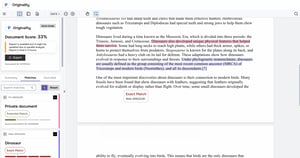
The similarity report appears as an overlay on the submission inside WISEflow, so staff stay in context and move faster.


TOUCH
SEMANTIC DETECTION
SEMANTIC DETECTION Originality goes beyond simple text matches by using semantic detection to identify paraphrasing and meaninglevel similarity across languages.  
TOUCH
INTEROPERABILITY
INTEROPERABILITY

The service is interoperable by design and can be used within WISEflow or embedded in leading LMS/VLE platforms through an API-first approach.  

TOUCH
COMPLIANCE
COMPLIANCE Institutions retain full control over privacy and governance with granular sharing groups and indexing options. 

CASE: UNIVERSITY OF COPENHAGEN

University of Copenhagen selects WISEflow as its digital assessment platform and WISEflow Originality for plagiarism detection 


KU city_foraar_high

HOW TO CHOOSE A PLAGIARISM DETECTION TOOL

Plagiarism detection is no longer a simple matter of matching strings of text. As universities grapple with the dual challenges of AI-generated content and ever-more sophisticated paraphrasing, the tools and policies we choose matter more than ever.


Exams BYOD

WANT TO GET IN TOUCH WITH AN EXPERT?

Book a demo to learn more about how UNIwise can support you on your digital assessment journey. 

COMMON QUESTIONS FROM HIGHER EDUCATION INSTITUTIONS

What is WISEflow Originality?
WISEflow Originality is an AI‑powered similarity and paraphrasing detection service built directly into the WISEflow marking workflow. It identifies meaningful similarity across languages, highlights evidence clearly for assessors, and gives institutions full control over privacy, indexing and source management without extra logins or context switching.
Why choose WISEflow Originality over other tools?
WISEflow Originality goes beyond legacy text‑matching by detecting paraphrasing and cross‑language similarity using semantic AI. It is embedded directly in the marking workflow, reducing assessor time. Institutions can control exactly what is scanned, indexed and shared, ensuring GDPR‑compliant governance. Pricing is transparent, and the solution has been chosen in competitive tenders for its combined functionality, workflow fit and value.
How does Originality support governance & oversight?
Administrators get a central dashboard to manage users, sources and ad‑hoc uploads, with full audit trails. Oversight stays with the licence team, ensuring consistent and transparent processes.
Can we choose which documents are indexed vs. scanned?
Yes. Submissions can be scanned without indexing, or selectively indexed for future comparison, controlled at the licence level.
How does the service handle GDPR and data privacy?
It follows a privacy‑by‑design approach with EU‑centric processing. Institutions choose what is scanned, indexed or shared using granular permissions and sharing groups.
Do assessors need to switch systems to see similarity results?
No. Reports appear as an overlay within the WISEflow marking tool, so assessors stay in context and move faster.
Are similarity signals easy to interpret?
Yes. Matches are grouped into Exact, Strong and Potential categories with sentence‑level highlights for fast, confident judgement.
Does it detect paraphrasing and cross‑language similarity?
Yes. AI‑driven semantic similarity identifies paraphrasing, rewritten content and similarity across 50+ languages.
Can we define specific internet resources for scanning?
Yes. Licence‑specific URL lists can be added to tailor scanning to local needs.
How does it handle student‑to‑student copying?
Cross‑flow and cross‑institution matching reveals student‑to‑student overlap. Parallel checks reduce “who submitted first” bias in same‑day submissions.
Can it integrate with our LMS/VLE (Canvas, Moodle, Brightspace, etc.)? Yes. It uses an API‑first, LTI‑friendly approach compatible with major LMS/VLE platforms.
How does WISEflow Originality reduce operational overhead?
Because the report is built directly into the marking workflow, assessors avoid context switching, significantly reducing marking time and administrative load.
Is there evidence from recent tenders?
Yes. Originality has been selected via competitive public tenders based on a combination of functionality, value and privacy compliance.