Why institutions choose WISEflow over Moodle for digital examinations and assessment
Moodle is a great LMS, but high-stakes exams need more. Why institutions pair Moodle with WISEflow for end-to-end, auditable digital examinations.
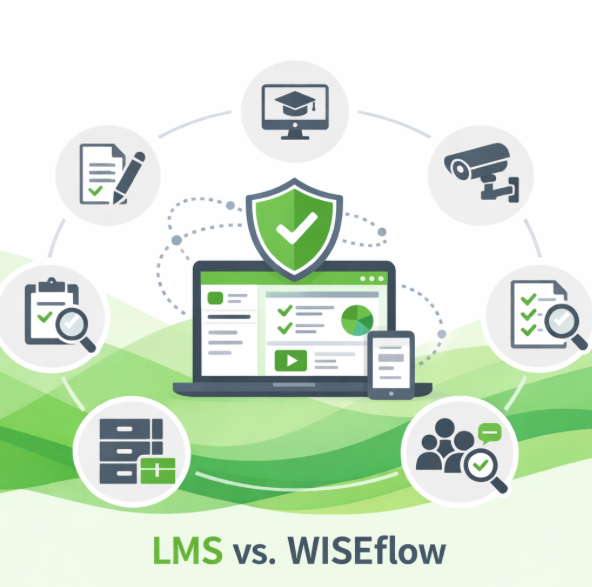
Moodle is an excellent Learning Management System (LMS). But high stakes examinations and end-to-end assessment demand a different class of platform. One that orchestrates authorship, delivery, invigilation, marking, moderation, feedback and archiving under a single, auditable control framework. That is where WISEflow excels.
Moodle is a great LMS and that matters
As a virtual learning environment, Moodle shines: course delivery, discussion, content authoring, gradebooks and an extensive plugin ecosystem. Many universities have invested years in Moodle-based teaching workflows, and rightly so.
Constraints appear, however, when teaching-centric tools are stretched to cover examinations and summative assessment at scale, where integrity, standardisation, evidence and governance dominate.
7 assessment essentials: LMS reality vs. WISEflow's answer
1. End-to-end orchestration
LMS reality: High stakes exams stitched together from core LMS features plus multiple plugins quickly become a brittle patchwork. Admin teams must coordinate roles, tasks and handoffs across tools that were never designed to operate as one coherent exam workflow.
WISEflow’s answer: A purpose-built assessment platform that orchestrates authorship, delivery, invigilation, marking, moderation, feedback and archiving under a single model. Fewer handoffs, fewer surprises, and one audit trail from start to finish.
2. The hidden cost of self-host & plug-ins
LMS reality: Many institutions self-host Moodle and maintain the assessment plugins themselves. On paper it looks cost-effective; in practice it adds operational drag: patching core and multiple plugins, validating compatibility after each upgrade, and coordinating release windows across the stack. It also introduces recruitment risk - finding and retaining people who combine LMS administration, security, assessment policy and integration skills is hard.
WISEflow’s answer: Assessment delivered as a managed service with controlled releases, clear change communications and platform-level governance. Institutions reduce their dependency on scarce hybrid skill sets and free up local teams to focus on policy, pedagogy and student experience.
3. Compliance & assurance (one control framework)
LMS reality: When assessment runs via an LMS plus plugins from different vendors, compliance is hard to execute end-to-end. Each module can handle data differently, rely on its own sub-processors and ship on its own cadence. The result? A patchwork with hidden corners of security and many moving parts, making DPIAs, Article 32 controls, incident response and audits harder to perform confidently across the whole chain.
WISEflow’s answer: A single, purpose-built platform with a unified control framework - security governance, regular independent testing and clear documentation are centralised. Because authorship, delivery, invigilation, marking and archiving run inside the same platform, the audit trail is coherent, exportable and defensible.
4. Academic integrity & secure delivery
LMS reality: Quiz tools are excellent for formative use, but closed book or invigilated conditions typically require extra components, policies and manual checks - raising operational risk and eroding confidence at scale.
WISEflow’s answer: Multiple integrity models: traditional lockdown delivery when you need it, and monitored open book options that record activity and flag risks in real time and post-exam. Institutions get the flexibility to run authentic, software-based tasks (e.g., spreadsheets, coding tools) without sacrificing oversight.
5. Data protection, residency & processor discipline
LMS reality: An LMS plus plug-ins approach multiplies data flows and third party exposure. That expands the number of data processing agreements, impact assessments and transfer mechanisms to manage each with its own terms, updates and potential gaps.
WISEflow’s answer: Clear data processing terms and documented technical and organisational measures, EU centric hosting and disciplined sub-processor management. Encryption, access control and logging are handled consistently across the assessment lifecycle rather than varying by plugin. Central penetration test, weekly vulnerability scans and 365 monitoring and annual ISO27001 auditing guarantees your data is safe.
6. Accessibility by design
LMS reality: Accessibility in teaching workflows can be strong, but exam interactions are different stress tests: timers, navigation, item rendering and proctoring interfaces. In a plugin ecosystem, accessibility patterns and quality vary by module and theme, increasing the burden on local teams to validate consistency across the entire exam journey. That often results in students with disabilities must be supported and thus reside outside the LMS and handled more manually.
WISEflow’s answer: Platform-level conformance to recognised accessibility standards and an active improvement programme across roles and flows. Evidence and accountability live in one place, reducing the need to police accessibility plugin by plugin, and secure that students alike can be accommodated within the same platform and thus not discriminate between them.
7. Governance, retention & defensibility
LMS reality: Assessment artefacts and logs often end up dispersed across plugins, inboxes and file shares which complicates retention schedules, discovery for appeals and external examiner reviews, and the ability to show a single chain of custody.
WISEflow’s answer: Coherent retention and deletion controls (with options to extend for statutory archiving) and unified workflow/log data with submissions. Appeals, moderation and quality audits are supported by a single source of truth.
To sum up: Moodle or Learning Management Systems (LMS/VLE) are built for class events and teaching and learning activities. They have ‘the class’ as its core entity and supports that interaction workflow between teacher and student you find in classes. However, WISEflow is built for exams and assessment, and have ‘the exam’ as its core entity, and thus is designed to support the whole workflow, that goes into conducting these end-to–end in all their varied forms and with all the different roles that needs to be part of it.
Integrate. Don't duplicate. 3 paths
You don’t have to choose between your LMS and a specialist exam platform like WISEflow. Keep Moodle for teaching; let WISEflow govern exams and high stakes assessment joined up through standards and open interfaces. The aim is simple: place WISEflow in mix of your digital estate without lock-in, and let each system do what it does best.
Path 1
LTI 1.3 for an LMSfirst experience
If your academics live in Moodle every day, LTI keeps their journey simple while putting exam delivery under WISEflow’s control:
- Deep linking allows educators to create and place WISEflow assessments from inside Moodle.
- Names & Roles (rostering) provisions the right people into the right roles at the right time.
- Students launch assessment activities from a familiar LMS context, while WISEflow provides the integrity, workflow and audit depth needed for exams.
Path 2
Open APIs for enterprise grade automation
When you want institution-level control and data mobility, use WISEflow’s APIs to automate the heavy lifting:
- Create flows, enrol candidates and allocate assessors from central systems.
- Push outcomes and artefacts to records management, archives and BI dashboards.
- Combine with authentication and directory services so identity and permissions remain authoritative.
Path 3
SISfirst orchestration when Moodle is not the data source
If your Student Information System (SIS) is the source of truth for enrolments and exam timetables, connect WISEflow to your SIS directly for schedules and cohorts. Then choose how you surface assessments:
- Surface to Moodle via LTI where teaching teams want visibility.
- Run independently of Moodle for programmes that do not use the LMS.
This keeps master data authoritative in the SIS while WISEflow orchestrates exams and maintains the end-to-end audit trail.
Identity, access & national eIDs
Place WISEflow behind your preferred SSO (SAML/OIDC) or national identity service so users authenticate once and permissions follow them across systems. No extra passwords, no duplicate role management.
The net effect
- No rip and replace: Moodle continues as your VLE; WISEflow becomes your assessment backbone.
- Your ecosystem, your way: pick the right path for each faculty - LTI, APIs or SIS-first - and mix them where it makes sense.
- Right system of record: SIS or LMS can stay authoritative; WISEflow orchestrates exams and maintains the audit trail.
A practical checklist for digital exam readiness
When evaluating Moodle only versus Moodle and WISEflow, bring these decisions into one room:
1. Workflow: Can we run the entire exam process in one place with role secure permissions and a single, exportable audit trail?
2. Hidden cost: How much local effort will we spend maintaining plugins, validating upgrades and recruiting/retaining the hybrid skills to keep it all running?
3. Compliance: What concrete evidence can we produce on security governance, testing cadence and change control - without chasing multiple plugin owners?
4. Data flows: Are sub-processors, residency and encryption clear, governed and limited - so data handling is predictable end-to-end?
5. Accessibility: Is accessibility designed into exam experiences for all roles, not just asserted at the LMS level?
6. Integrity options: Which delivery models do we support (lockdown and monitored open-book), and can invigilators act on flags in real time and after the exam?
7. Retention & appeals: Can we apply retention and archiving consistently, with one chain of custody for appeals and audits?
8. Integration choices: For our context, which path fits best - LTI for an LMSfirst teaching experience, APIs for deeper automation, SIS-first when Moodle is not the data source, or a hybrid approach?
The bottom line
Moodle and other Learning Management Systems remains a powerful, cost effective platform for teaching and learning. For examinations and summative assessment, institutions benefit from a platform whose DNA is assessment unifying workflow, integrity, compliance and evidence. That is the design centre of WISEflow.
We are here to help
Whether you are just starting with digital assessment or want to get more out of it, we are happy to share how other institutions run it in practice. Please reach out or request a demo.

Frequently asked questions
Moodle is built for teaching workflows, not for end‑to‑end examinations. When used for high‑stakes assessment, universities must stitch together plugins, policies and manual processes creating operational risk, governance gaps and inconsistent user experiences.
WISEflow centralises everything: authorship, delivery, invigilation, marking, moderation, feedback and archiving.
This means:
- One workflow
- One permissions model
- One audit trail
- Fewer handoffs and fewer surprises
Self‑hosting Moodle and maintaining assessment plugins requires:
- Continuous patching
- Compatibility testing
- Complex upgrade coordination
- Hybrid skill sets (LMS + security + integrations)
WISEflow removes this burden with a fully managed assessment service and controlled releases.
Moodle + plugins = many sub-processors, data flows, release cycles and documentation gaps.
WISEflow = a unified control framework with:
- Clear security governance
- Regular PEN testing and monitoring
- ISO27001 audits
- Coherent, exportable audit trails
Plugin ecosystems lead to uneven accessibility across modules.
WISEflow ensures:
- Platform‑level accessibility
- Consistent interaction patterns across roles
- Students with accommodations remain within the same platform
While Moodle quizzes are great for formative tasks, authentic and secure exam conditions require more. WISEflow offers:
- Lockdown delivery when needed
- Monitored open‑book modes with real-time flags
- Support for authentic digital tools (coding, spreadsheets, etc.)
Yes, seamlessly. Institutions choose from three paths:
- LTI 1.3: LMS‑first teacher experience
- APIs: automation and enterprise orchestration
- SIS‑first: WISEflow orchestrates exams directly from SIS
No rip‑and‑replace required. Moodle continues as the VLE; WISEflow becomes the assessment backbone.