
Strategic partnership in digital assessment - navigating change through dialogue
Why strategic partnership matters in digital assessment, and how structured dialogue between universities and UNIwise supports reliable exams and change.
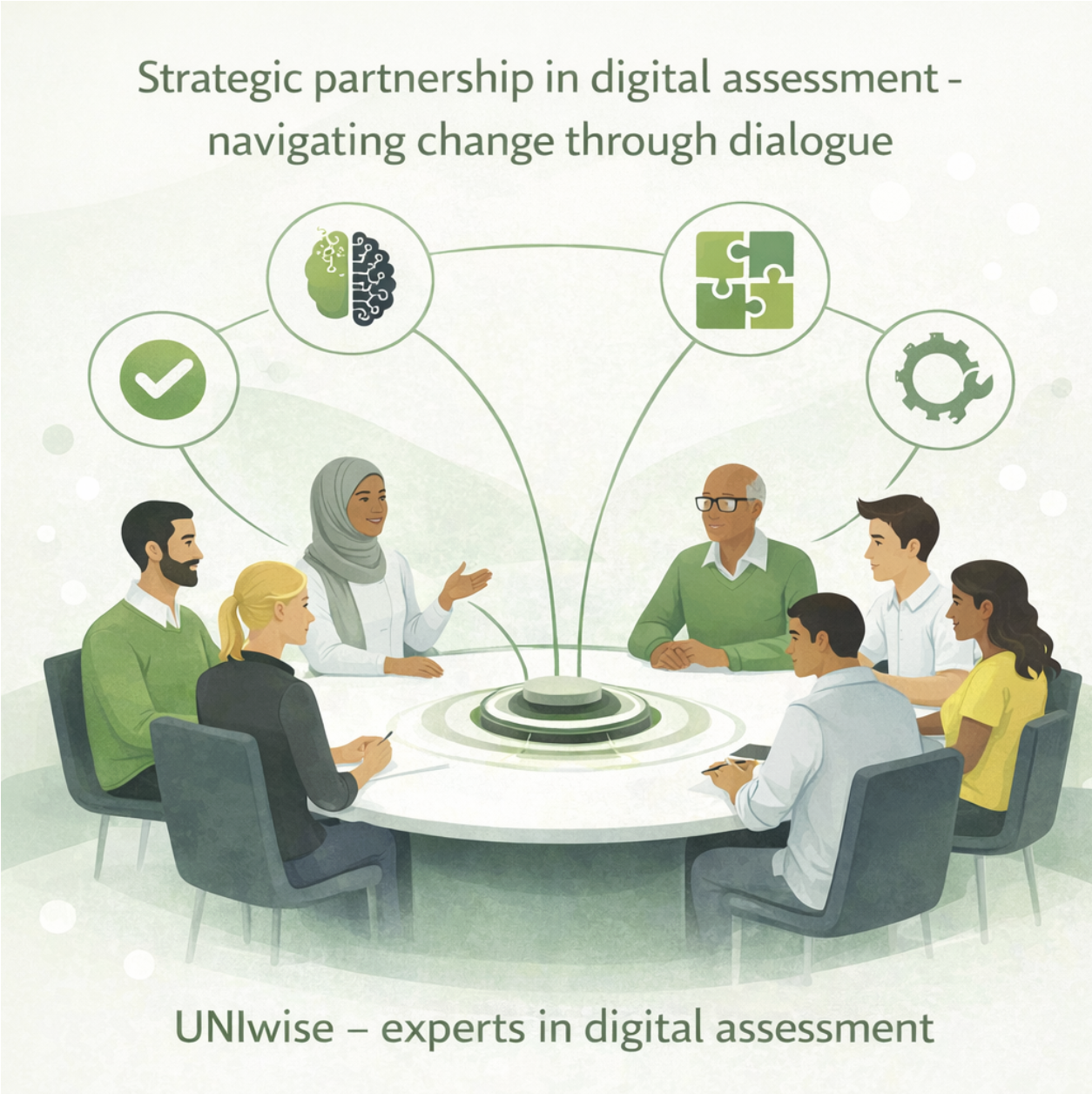
Digital exams are among the most critical services a university delivers. When assessment windows open, there is very little room for ambiguity: the system must work, communication must be clear, and trust between institutions and suppliers becomes a practical necessity - not a nice-to-have.
That reality is one of the reasons we believe it is not enough to be “just” a provider of an exam platform. In higher education, an assessment platform sits at the intersection of pedagogy, policy, compliance, integration, operations, and student experience. If we treat it as “software only”, we risk solving the wrong problems - or solving them only for the loudest voices rather than for the shared needs of the sector.
At UNIwise, we use the word partnership deliberately. Not as a logo exercise. Not as a marketing label. But as a structured collaboration where we identify, discuss, and address the strategic challenges we can already see on the horizon - together.
Why being a vendor isn't enough
A university’s assessment practice is rarely “one system, one workflow, one stakeholder”. It is a complex landscape involving multiple roles, multiple vendors, and multiple institutional priorities. In that reality, professionalism and transparency matter - and long-term trust is built through openness, responsiveness, and shared responsibility, not through perfection.
From our customers’ perspective, the value of a digital assessment platform is not defined only by features. It is also defined by whether the supplier understands the operational realities of higher education and takes responsibility for the role digital exams play within the institution. This is exactly where partnership becomes practical: it creates a forum for alignment, shared understanding, and coordinated progress - not only when something breaks, but especially when the sector changes.
What we mean by "partnership" (and what we don't)
When we talk about partnership, we mean a collaborative space that goes beyond immediate solutions and focuses on long-term strategies, shared visions, and the evolving education landscape.
Partnership, for us, is built around a few core principles:
- Shared challenges require shared solutions. Partners and UNIwise bring different vantage points, but we face many of the same future pressures - so we treat these as joint problems to solve.
- Diversity of perspectives beats volume of opinions. We aim to surface multiple realities across institutions and markets and turn them into more robust, scalable solutions.
- Structured dialogue beats ad hoc escalation. Collaboration works best when it is organised: with a cadence, clear forums, and a shared agenda - rather than last-minute requests and reactive fixes.
- Technology is a tool to achieve shared goals. The platform matters - but it is in service of outcomes: reliable operations, better workflows, fairer assessments, and future-ready practice.
What partnership is not: a promise of bespoke development on demand. It is a strategic collaboration model that helps us prioritise, shape, and validate work that benefits partners - and, over time, the wider customer community.
From collaboration to a programme - how we organize partnership
Over the past years, our partner institutions have played a substantial role in shaping the future of WISEflow. We recognise that a valuable aspect of partnership is the strategic dialogues and shared visions that help us navigate the changing educational landscape together.
While the exact format evolves, the pillars remain consistent:
- Partner seminars and strategic forums to align direction, share updates, and bring strategic perspectives into focus (we gather partner customers at least twice a year).
- Advisory collaboration where partners suggest themes and advise on what should be prioritised - informing our themed roadmap and the value we aim to deliver.
- Theme advisory groups attached to major initiatives, helping us understand objectives, real-world use cases, and the practical implications of design choices.
- Working sessions and solution reviews where we test, discuss, and refine ideas together, including best-practice consultancy around usage.
- Quarterly strategic and service reviews to evaluate whether we are helping partners reach institutional goals - and to adjust together when priorities change.
- Support for interoperability and integrations, because assessment does not live in isolation and robust integrations are essential for sustainable operations.
This is the operational meaning of partnership: not a one-off workshop, but a repeatable pattern of collaboration that supports both short-term wins and long-term direction.
Partnership in practice - turning sector pressure into shared priorities
Every partner seminar raises new topics for in-depth discussion - alongside recurring agenda items such as roadmap and strategic outlook. For example, partner discussions have explicitly focused on the impact of financial pressure and budget cuts across institutions, and the urgent need to “do more with less”. These are not challenges a platform vendor can solve alone; they require coordinated thinking about processes, roles, and where technology can truly remove friction.
Similarly, the sector is navigating fast-moving change in areas like AI. In our partner context, this has included concrete themes and updates related to “AI Feedback” and roadmap work that includes AI-assisted feedback and authoring. The value of partnership here is not only building features, but creating a shared understanding of what good looks like in practice - quality, assurance, governance, and adoption strategy, not just novelty.

And because stable digital assessment is infrastructure, our roadmap work must balance multiple categories at once: maintenance (stability, scalability, security, accessibility), strategic initiatives (anticipated future requirements), partner themes (essential improvements identified by key customers), and - where appropriate - limited bespoke work for truly critical needs. Partnership helps us navigate those trade-offs transparently.
Finally, partnership works best when it strengthens the wider community around assessment. That is why our partner seminars are not only about “what we build next”, but also about sharing initiatives, exchanging good practice, and learning across institutions. And importantly - it is not a closed club. If institutions want to explore partnership, the door should be open to joining a collaborative journey built on shared learning and shared progress.
Partnership is how we make digital assessment sustainable
Complex conditions do not call for simple solutions. They call for collaboration - where institutions and suppliers bring their best thinking, share responsibility, and build sustainable practice together. That is what we mean by partnership at UNIwise. Not a claim. A commitment - grounded in strategic dialogue, structured collaboration, and a shared focus on the realities of higher education assessment.
If your institution is looking for more than a platform - if you want a partner that takes the role of digital assessment seriously - we would love to explore what meaningful collaboration could look like in your context.
We are here to help
Whether you are just starting with digital assessment or want to get more out of it, we are happy to share how other institutions run it in practice. Please reach out or request a demo.
Frequently asked questions
Because digital assessment is not just software. It sits at the intersection of pedagogy, policy, compliance, operations, and student experience. Treating it as a partnership ensures these interconnected realities are addressed together, not in isolation.
Partnership helps institutions manage ongoing change in areas such as assessment design, financial pressure, system integration, AI adoption, and governance, through shared understanding rather than reactive fixes.
Partnership means structured, long‑term collaboration focused on shared challenges, strategic alignment, and coordinated progress. It is not ad hoc escalation or bespoke development on demand, but a repeatable model for mutual learning and prioritisation.
The partnership model includes regular partner seminars, advisory collaboration on roadmap themes, theme‑specific working groups, solution reviews, quarterly strategic and service reviews, and active support for integrations and interoperability.
By fostering transparency, responsiveness, and shared responsibility, partnership ensures that operational realities are understood in advance, so systems, communication, and expectations hold up when assessment windows open.
Partnership encourages sharing best practices, aligning priorities across institutions, and shaping solutions that scale beyond individual needs, strengthening the overall digital assessment ecosystem rather than creating isolated outcomes.