
Rubrics are not paperwork - they are quality assurance
Why rubrics are a quality-assurance tool in higher education, driving fair and consistent marking, clearer feedback and better assessment design.
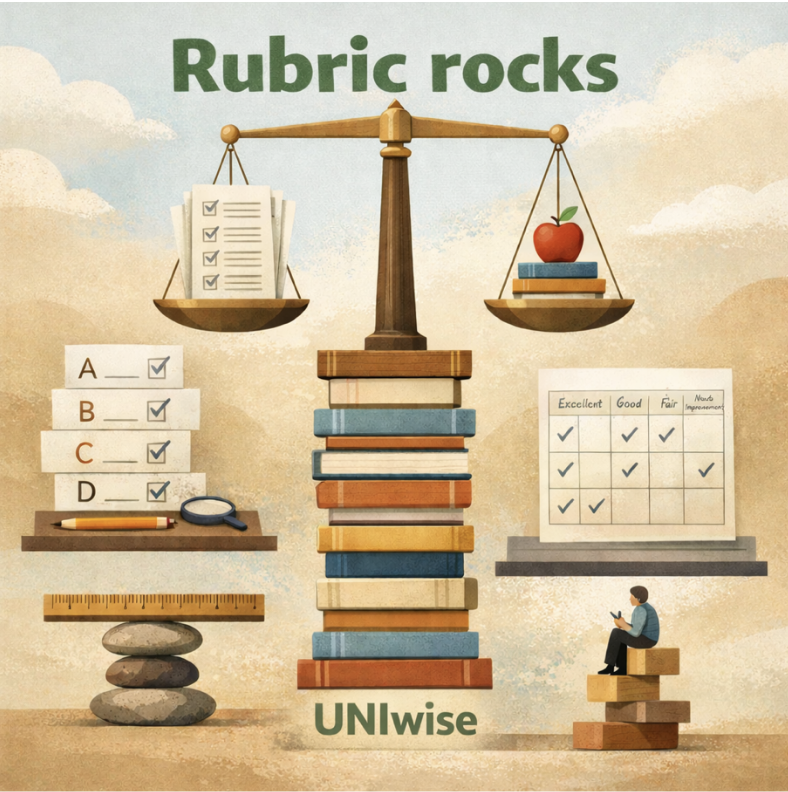
In conversations about assessment, rubrics are often treated as something peripheral. A pedagogical add-on. A document you attach because you are supposed to. At UNIwise this could at times seem like rubrics live a secret life on its own. However, in practice, a well-designed rubric is one of the most powerful quality mechanisms an institution can put in place, and it should be used and celebrated more. Not because it looks tidy. But because it makes assessment fairer, more consistent, easier to operate at scale, and easier to defend.
At a time when assessment is under pressure, from larger cohorts, multiple markers, tighter turnaround requirements and increasing scrutiny of grading decisions, rubrics are quietly doing work that no technology feature can compensate for.
The real problems rubrics solve
Most assessment challenges do not start with technology. They start with ambiguity. When expectations are unclear, students guess. When criteria are implicit, markers interpret. And when multiple assessors work under time pressure, variation is inevitable, even with the best intentions.
This is where rubrics matter. A rubric makes assessment criteria explicit. It turns tacit judgement into shared reference points. That has several practical consequences:
- Students understand what quality looks like before they submit.
- Markers assess against the same criteria, not personal benchmarks.
- Grades can be explained, not just asserted.
- Feedback becomes more focused and actionable.
- Appeals are handled with evidence, not recollection.
In other words, rubrics reduce friction everywhere assessment usually breaks down.
Fairness is not subjective - it is designed
Fairness in assessment is often discussed as an abstract principle. In reality, fairness is operational. It is about whether two students who produce work of comparable quality are likely to receive comparable outcomes — regardless of who marks the work, when it is marked, or under what conditions.
In courses with multiple markers or large cohorts, this is where most risk sits. Without a shared frame of reference, markers inevitably calibrate against their own experience. That is not a failure of professionalism — it is a natural human response to ambiguity.
Rubrics counter this by:
- Anchoring judgement to defined criteria rather than general impressions
- Reducing unconscious bias by narrowing interpretative space
- Creating consistency across markers, modules and cohorts
When institutions talk about fairness, this is what they mean in practice. And it does not happen by accident.
Rubrics also save time - when used properly
A rubric gives structure to marking. Instead of composing feedback from scratch for every submission, markers can focus on evaluating evidence against criteria and adding targeted comments where they matter most.
This has three effects:
- Marking becomes faster, because cognitive load is reduced.
- Feedback becomes clearer, because it is anchored to criteria rather than free text.
- Consistency improves, even when marking is distributed.
This is particularly important where turnaround times are fixed and nonnegotiable. Rubrics do not remove academic judgement — they focus it.
Reflection and improvement, not just grading
Rubrics are not only for assigning grades. They are also tools for reflection. For students, a rubric makes it easier to understand why they received a particular outcome and what they need to improve next time. That supports learning beyond the single assessment event.
For educators, rubrics surface patterns. When many students struggle against the same criterion, that is feedback on the assessment design or the teaching, not just on student performance.
Over time, this creates a feedback loop that improves assessment quality at programme level, not just at individual assignment level.

Where rubrics often go wrong
Despite their potential, rubrics frequently underperform. Not because the idea is flawed, but because the execution is. Three common pitfalls show up repeatedly:
Rubrics that are too vague
Labels such as “good”, “very good” or “excellent” without clear descriptors do little to support consistency. They simply rename subjectivity.
Rubrics that are too granular
Over-engineered rubrics with dozens of criteria and micro-levels turn assessment into a box-ticking exercise. They slow marking down and dilute academic judgement.
Rubrics exist outside the workflow
If rubrics live in a PDF or policy document but are not actively used during marking, they will not change outcomes.
A rubric only creates value when it is integrated into the actual assessment practice.
A minimum viable rubric
Perfection is not required. In many cases, a “minimum viable rubric” is far more effective than an elaborate framework. A practical starting point often looks like this:
- 4–6 clear criteria linked directly to learning outcomes
- 4 performance levels with meaningful descriptors
- One or two examples of evidence per level
- A short marker calibration discussion before marking begins
The alignment to learning outcomes is critical. Where learning outcomes are defined, the rubric should make that relationship explicit. Where they are not, the rubric effectively becomes the de facto articulation of what quality means in that assessment.
This does not remove academic judgement. It aligns it.
How rubrics are incorporated in WISEflow
In WISEflow, rubrics are designed to be part of the assessment workflow — not an external artefact. You design, develop and attach rubrics prior to the assessment, and use it when students have handed in and you go marking. You can also share your rubrics, or re-use them – and most importantly, you can make them available prior to the assessment, so student know how scoring will look. This is real transparency.
Using the rubrics allows assessors to evaluate submissions against shared criteria while retaining full academic control over the final judgement. In practice, this supports:
- Consistency across markers, as everyone works from the same structured criteria
- Clearer, criteria-aligned feedback for students
- More efficient marking workflows, especially in large cohorts
- Stronger defensibility in cases of grade review or appeal
Because rubrics are embedded in the marking process, they move from being “guidance” to being an operational tool — supporting both academic quality and institutional assurance without constraining professional judgement.
Why this matters now
Assessment is under increasing scrutiny, from students, institutions, regulators and external examiners. Transparency, consistency and defensibility are no longer optional.
Rubrics sit at the intersection of pedagogy and governance. They support better learning experiences, but they also provide the evidence institutions need when grades are questioned or processes are reviewed. In that sense, rubrics are not just teaching tools. They are quality assurance mechanisms. And they are among the most cost-effective ones available.
Key takeaways
- Fair assessment does not emerge from good intentions, it is designed.
- Rubrics make expectations explicit for students and markers alike.
- Used well, rubrics improve consistency, reduce marking time and strengthen feedback.
- They also provide a defensible basis for grading decisions and appeals.
- If rubrics exist only as documents, their potential is wasted.
For many institutions, rubrics already exist, but often only as documents, templates, or policy requirements. The real shift happens when rubrics move from being descriptive to being operational: when they actively shape marking, feedback and decision-making in day-to-day assessment work.

If you are currently reviewing assessment practices, preparing for a new exam period, or trying to improve consistency across markers or programmes, it may be worth taking a step back and asking a simple question:
Are our criteria actually doing the work we expect them to do?
That is usually a productive place to start a conversation — not about tools or features, but about assessment quality, fairness and confidence in outcomes.
We are here to help
Whether you are just starting with digital assessment or want to get more out of it, we are happy to share how other institutions run it in practice. Please reach out or request a demo.

Frequently asked questions
Rubrics are powerful quality assurance tools. They make expectations explicit, reduce ambiguity for students and markers, and create consistency across cohorts, markers, and modules. Rather than being an add‑on, they safeguard fairness and strengthen academic defensibility.
Fairness becomes operational when rubrics anchor judgement to shared, clearly defined criteria. This reduces unconscious bias, ensures comparable work receives comparable outcomes, and supports consistent marking regardless of who marks or when marking occurs.
Yes. Well‑designed rubrics reduce cognitive load by providing structure during marking. They streamline feedback, speed up decision‑making, and allow markers to focus on evidence rather than generating comments from scratch, especially helpful in large cohorts or tight turnaround periods.
Rubrics help students understand what quality looks like before they submit, and they clarify why they received a particular grade. By highlighting strengths and areas for improvement, rubrics create a feedback loop that enhances learning beyond a single assessment event.
Rubrics fail when they are too vague (“good/excellent”), too granular with excessive micro‑criteria, or exist only as documents rather than being integrated into actual marking workflows. A rubric only adds value when actively used during assessment.
In WISEflow, rubrics are built into the marking workflow. Assessors apply them directly during evaluation, share them with students beforehand for transparency, reuse them across assessments, and rely on them for consistent grading, clearer feedback, and stronger auditability during reviews or appeals.