
Open-book exams with evidence - moving beyond lockdown
How universities can move beyond strict lockdown with evidence-based invigilation for open-book and tool-based exams, balancing integrity and authenticity.
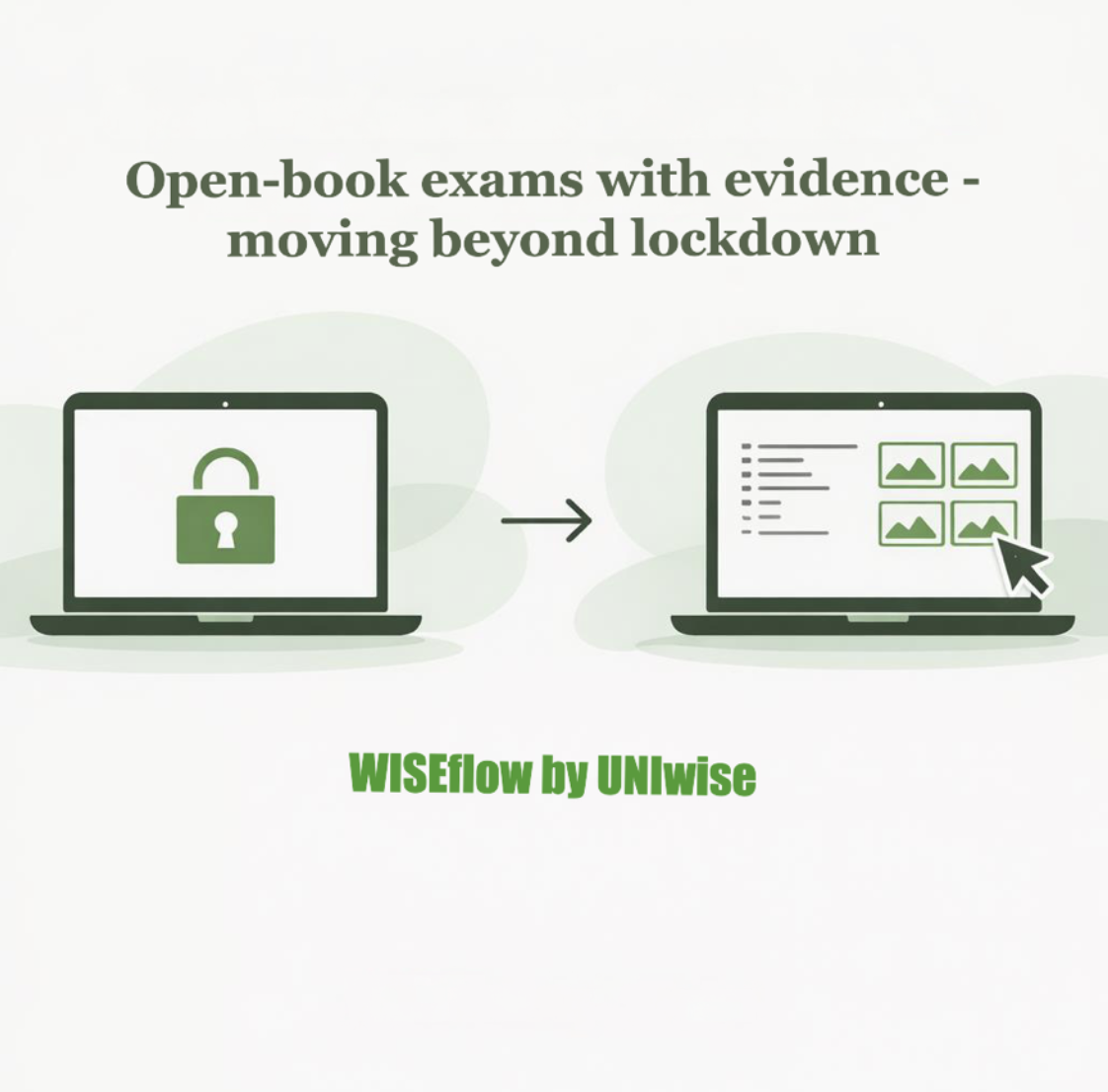
Open-book and tool-based exams are growing - but lockdown isn’t always the right fit. A proportional, evidence-based invigilation model can protect integrity while supporting authentic assessment workflows.
The problem we keep trying to solve with one tool
Universities want two things at once: assessment that reflects real practice, and results that can be trusted. Increasingly, those two collide in digital exams. The more authentic the task becomes, the more likely it is to require specialist tools: spreadsheets, coding environments, modelling software, or discipline-specific applications. In those settings, a strict lockdown approach can become a blunt instrument - it either blocks the workflow entirely, or forces a redesign of the assessment that undermines the very competence it was meant to certify.
This is why many institutions are moving toward “exam tiers” - not because they are relaxing standards, but because integrity is best protected when the security model matches the assessment model. A closed-book, highly standardised exam is one thing. A tool-based open-book exam is another. Trying to treat them the same creates friction, exceptions, and disputes.
Two integrity models - prevention vs evidence
In practice, digital exam integrity tends to follow two broad models. Model 1: prevention (lockdown) A lockdown browser is designed to prevent common forms of opportunistic cheating on-device by restricting access to the desktop and limiting students to permitted tools and resources. In WISEflow, this is the familiar FLOWlock approach, where the student is “locked in” to a controlled exam environment. Model 2: evidence (monitor and review) When prevention is not feasible or not desirable, integrity can be protected through monitoring, logging, and human review. This is the familiar WISEflow Device Monitor approach. Instead of trying to block everything technically, the institution makes expectations explicit (what is allowed and what is not), and collects evidence during the assessment window to support invigilation and post-exam investigation when needed
Neither model is “better” in the abstract. The question is which model best supports the assessment purpose without creating unnecessary risk, cost, or unintended pedagogical distortion.
Why evidence-based invigilation is becoming more relevant
Evidence-based invigilation becomes relevant when any of the following is true:
- The exam is open-book by design, and the goal is not to block resources, but to ensure students follow agreed rules (for example, no unauthorised collaboration).
- The exam is tool-based, requiring applications that are difficult or impossible to support in a locked environment.
- The institution needs auditability, meaning it must be able to investigate suspected incidents with documented evidence rather than assumptions or hearsay.
A key governance point matters here: monitoring is not proof of misconduct. It is a basis for investigation. Good practice is to treat logs and recordings as indicators that warrant review - not automatic conviction. This protects both students and institutions by ensuring decisions are grounded in human judgement and due process.
What "good" looks like - proportional invigilation
If an institution chooses an evidence-based model, success depends less on technology and more on governance. The most defensible setups tend to share four characteristics
1. Clear rules and expectations
Students need a simple explanation of what is permitted (for example, which tools are allowed) and what counts as misconduct (for example, communication with others). The integrity model must be understandable, not just enforceable. 2. Transparency about monitoring
If an exam collects screen evidence, application data, or other behavioural signals, students should be informed clearly - what is collected, when, and why. A visible indicator during the session also reduces ambiguity. In WISEflow Device Monitor, the monitoring is bounded to the participation period by design, and there are explicit behaviours and clarifications communicated to institutions. 3. Human review and consistent handling
Evidence is only useful if review is consistent. Institutions benefit from defining a small set of review routines: what triggers follow-up, who reviews, and what documentation is required for decisions. Monitoring outputs should prompt further inquiry, not replace it. 4. Data minimisation and retention discipline
Monitoring generates large volumes of data. A proportional approach means collecting only what is necessary for the exam context, and retaining it for a defined, limited period aligned to institutional policy. UNIwise’s DPIA materials for WISEflow Device Monitor describe automatic deletion after six months and outline the scope and volume considerations.
A practical example - WISEflow Device Monitor
WISEflow Device Monitor is designed for precisely the scenarios where lockdown is not the right tool. It supports invigilated open-book exams by allowing the student full freedom on their device while collecting evidence through action logs, processor listing, and screen capture, so that unwanted actions can be flagged and investigated by invigilators during or after the exam
In other words, it reverses the lockdown logic. Instead of restricting the workflow, it enables authentic tool use while still giving the institution a basis for integrity review.

From a functionality perspective, UNIwise describes Device Monitor as including:
- Screen capture for monitoring purposes.
- Optional monitoring of running applications (application / process visibility).
- The ability to define prohibited applications.
And from a governance and compliance perspective, UNIwise maintains a DPIA framework specific to the Device Monitor processing, including defined retention and security controls.
A note on boundaries - the exam window matters
One of the most important safeguards in any monitoring setup is that monitoring remains strictly limited to the permitted assessment timeframe. UNIwise has communicated to institutions that WISEflow is designed not to accept or store screenshots beyond the participation period boundary, and that fixes and clarifications have been issued when unintended behaviour was identified.
This matters for trust. Students should never be left wondering whether monitoring continues “in the background” after the exam context ends. The boundary must be explicit, enforced, and explainable
Choosing the right model - a simple decision lens
When deciding between lockdown and evidence-based invigilation, institutions can ask three pragmatic questions:
- Does the assessment require authentic tool use?
If yes, a strict lockdown model may conflict with the intended competence demonstration. - Is the integrity objective about restricting access - or about documenting compliance with rules?
If the goal is to prevent access to resources, lockdown may fit. If the goal is to ensure rule compliance in an open-book setting, monitoring and review may be the better fit. - Can the institution support consistent review and due process?
Evidence-based models require human review discipline. If that capacity is not in place, institutions may need to define simpler exam tiers or smaller monitoring scopes.
Closing thought - integrity without distorting assessment
The future of exam integrity is unlikely to be a single technology choice. It is a design choice: matching invigilation to assessment purpose, and matching evidence collection to proportional governance.
Lockdown will remain valuable where closed-book restrictions are appropriate. But for open-book and tool-based exams, evidence-based invigilation provides a path that is often more realistic, more scalable, and more aligned with authentic assessment - while still producing the auditability institutions need when questions arise.
We are here to help
Whether you are just starting with digital assessment or want to get more out of it, we are happy to share how other institutions run it in practice. Please reach out or request a demo.

Frequently asked questions
Because many authentic assessments require specialist tools such as coding environments, spreadsheets, or modelling software. A strict lockdown browser can block these workflows or force redesigns that undermine the competencies the assessment is meant to measure.
There are two approaches:
- Prevention (lockdown): restricting access to devices and resources.
- Evidence‑based invigilation: allowing tool use while collecting monitoring evidence that can be reviewed by humans if concerns arise. The right choice depends on the assessment purpose.
Evidence‑based invigilation focuses on monitoring, logging, and review rather than blocking behaviour. It is suitable for open‑book, tool‑based exams where the goal is to ensure rule compliance and auditability rather than prevent all access to resources.
Monitoring data is treated as an indicator, not proof of misconduct. Institutions investigate flagged behaviour through defined review routines and human judgement, ensuring decisions are evidence‑based and defensible for both students and the institution.
Effective setups include clear exam rules, transparency about what is monitored, consistent human review processes, and disciplined data minimisation and retention. Governance matters as much as the technology itself.
WISEflow Device Monitor allows full tool use while collecting proportional evidence such as screen captures and application logs within the exam window. It supports auditability and investigation without imposing restrictive lockdowns, alongside defined DPIA, retention, and security controls.