
Compliance isn’t red tape - it’s how we protect students, staff and standards in European assessment
Why compliance is the engine of secure, fair and accessible assessment in European higher education, from GDPR and NIS2 to academic integrity.
Why universities should demand end-to-end, independently audited platforms, and why responsible vendors must help carry the compliance load.
The pain many universities feel right now
Across Europe, assessment teams are being asked to do three difficult things at once:
- Keep exams secure against leaks, impersonation, malware, and platform outages;
- Respect privacy and fundamental rights under stringent EU law; and
- Make assessment accessible to all learners, including students with disabilities, across a complex toolchain.
The reality on the ground is messy. Paper scripts still move between people and places without traceability. Ad hoc mixes of scanning tools, storage drives, and point solutions create unobserved gaps in the chain of custody. And when no single system covers the full exam lifecycle, there’s no single audit trail to prove who did what, when, and under which controls.
In 2026, this isn’t a “governance nice-to-have” — it’s a security risk.
Why compliance is the engine of security (especially in the EU)
European higher education operates in one of the world’s strongest regulatory environments for data protection, cybersecurity and accessibility. Far from being a burden, these frameworks push the sector toward safer, fairer assessment.
- GDPR sets a high bar for lawful processing, privacy by design/default, processor accountability and transfer safeguards. It is explicit about controller, processor duties, security of processing and documentation.
- NIS2 raises the bar on risk management, incident reporting and supply-chain security for “essential” and “important” entities and their providers, with board-level accountability and enforcement teeth.
- Accessibility: The EU Web Accessibility Directive (2016/2102) requires public-sector sites and apps (including universities) to meet the harmonised standard EN 301 549, itself aligned with WCAG 2.x.
- Cross-border data transfers: For any assessment data that touches US services, the EU-US Data Privacy Framework offers an adequacy route (for certified recipients), while the EDPB still expects Transfer Impact Assessments and supplementary measures where appropriate.
- Cyber threat level: ENISA’s first “state of the Union” report assessed the EU’s cyber threat level as substantial, highlighting ransomware, DDoS and supply-chain risk, all highly relevant to exams.
- Security assurance: ISO/IEC 27001 remains the globally recognised benchmark for an independently audited Information Security Management System (ISMS), aligning people, process, and technology around risk.
Bottom line: In Europe, compliance is the codified way we achieve security and fairness at scale. If vendors treat it as a checkbox, institutions carry unnecessary risk.
The case for end-to-end platforms (over paper and ad hoc tools)
Paper-based and fragmented workflows make it hard to guarantee:
- Chainofcustody & integrity: Who handled which script? Was anything lost or altered
- Least privilege & access logs: What access did invigilators, markers and IT support have
- Retention & deletion: Are copies lingering in inboxes, personal drives, or shadow tools
- Accessibility parity: Are alternative formats/equivalents consistently provided
- Incident response: Can you detect, investigate and remediate quickly across the whole process?
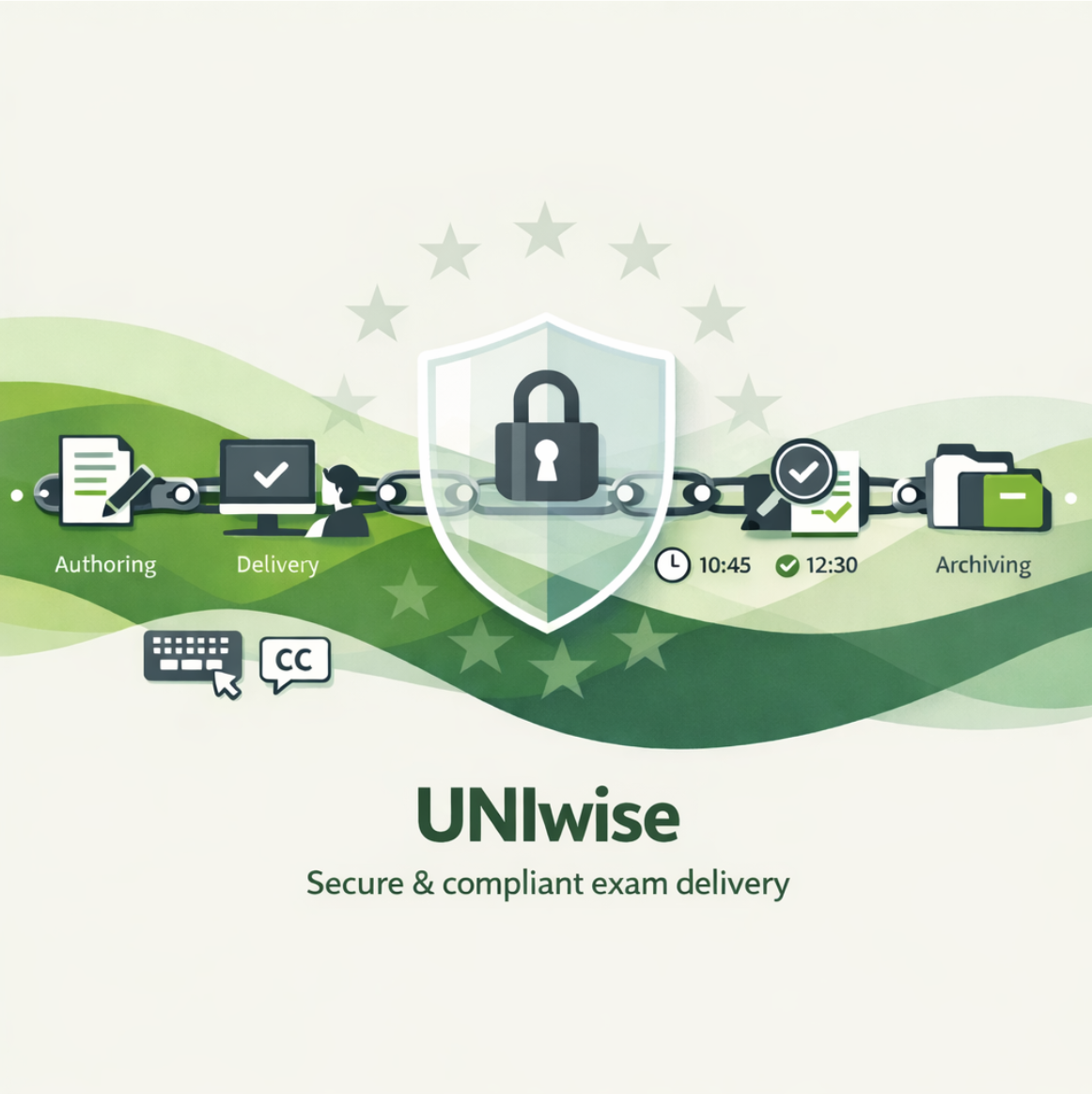
By contrast, a single, end-to-end assessment platform can enforce consistent controls, centralise logging, standardise retention, and offer one verifiable audit trail from authoring to marking to archiving. That’s not marketing jargon — it’s what lets Data Protection Officers, CISOs, auditors and external quality bodies see and verify what happened.
What universities should expect from suppliers
- Independent assurance
Vendors should operate an externally audited ISMS (e.g., ISO/IEC 27001), run regular vulnerability scanning and annual penetration tests, and provide assurance reports under NDA. - EUcentric data protection
Clear Data Processing Agreements, dataflow maps, EU data residency where required, and Transfer Impact Assessments or adequacy mechanisms for any third-country access. - Measurable accessibility
A current EN 301 549 / WCAG conformance statement and an improvement roadmap that tracks WCAG 2.2. - Academic integrity by design
Identity and authorship controls, anti-tamper measures, robust logging, and alignment with recognised integrity guidance - Operational transparency
A Trust Centre with live status, audit artefacts, sub-processor lists, and policy updates — available 24/7 to customers and prospects alike. (See Trust Centre reference below.)

How responsible vendors help universities lift their compliance workload
The best partners don’t just “pass audits.” They equip institutions to meet their own statutory and policy obligations by:
- Providing ready-to-use evidence packs: policies, pentest summaries, and DPIA templates.
- Publishing clear retention defaults, with knobs institutions can tighten (or relax) to match local policy.
- Offering role-appropriate dashboards and exportable audit trails so compliance teams can demonstrate control effectiveness quickly.
- Maintaining a transparent Trust Centre so stakeholders can self-serve the latest artefacts and service status.
This shared-responsibility approach builds trust — and saves time and cost during procurement, onboarding and periodic reviews.
Showcasing WISEflow
At UNIwise, our goal is the same as the university’s: rigorous, fair assessment that protects people and data. We’ve built WISEflow as an end-to-end digital assessment platform with security, privacy and accessibility designed in, and verified.
- Security governance & testing: WISEflow operates under a formal ISMS aligned with ISO/IEC 27001 and undergoes external security audits. We conduct biweekly automated vulnerability scanning and commission an annual external penetration test.
- Assurance reporting: We provide ISO 27001 assurance for control design and operation.
- Data protection: Our Data Processing Agreement and SCC/DPA materials set out EUcentric data residency and technical & organisational measures; additional detail is available under NDA.
- Accessibility: WISEflow maintains WCAG 2.2 AA conformance with an active programme towards WCAG 2.2 under EN 301 549.
- Transparency: Our UNIwise Trust Centre provides up-to-date compliance posture, security documentation, sub-processor information and system status: trust.uniwise.eu
End-to-end design means exam authorship, delivery, proctoring options, marking, reviewing, feedback, and archiving all run under the same control framework and audit trail — without paper detours or unmanaged shadow tools.
A practical checklist to discuss at your next governance or procurement meeting
- Do we have one audit trail for the whole exam lifecycle?
- Can our vendor provide independent audit/assurance artefacts on request?
- Are retention defaults sane, and can we shorten them easily?
- Where exactly is personal data stored and who (including sub-processors) can access it?
- Do we have a published accessibility statement aligned to EN 301 549 and WCAG 2.2?
- Is there a Trust Centre we can share with our DPO, CIS/IT and internal audit?
If any answer is “no” or “not sure,” that’s your immediate action item.
Conclusion
In European higher education, security and compliance are two sides of the same coin. Institutions serve students and staff best when they consolidate assessment workflows into platforms that are independently audited, privacy-by-design, and measurably accessible, and when suppliers step up with the transparency and evidence universities need. That’s the path to resilience, trust, and academic standards we can all stand behind.
Further reading - references
Regulation & standards
- GDPR (Regulation (EU) 2016/679): https://eur-lex.europa.eu/EN/legal-content/summary/general-data-protection-regulation-gdpr.html
- NIS2 Directive (EU) 2022/2555: https://eur-lex.europa.eu/eli/dir/2022/2555/oj/eng
- EU Web Accessibility Directive (2016/2102): https://eur-lex.europa.eu/eli/dir/2016/2102/oj/eng
- EN 301 549 (harmonised accessibility standard): https://www.wcag.com/compliance/en-301-549/
- WCAG 2.2 summary (W3C WAI): https://www.w3.org/TR/WCAG22/
- ISO/IEC 27001 overview (ISO). https://www.iso.org/standard/27001
Data transfers & guidance
- EU–US Data Privacy Framework — EU adequacy decision: https://ec.europa.eu/commission/presscorner/detail/en/ip_23_3721
- EDPB recommendations on supplementary measures (Schrems II): https://www.edpb.europa.eu/our-work-tools/our-documents/recommendations/recommendations-012020-measures-supplement-transfer_en
Threat landscape
- ENISA, 2024 Report on the State of the Cybersecurity in the Union: https://www.enisa.europa.eu/publications/2024-report-on-the-state-of-the-cybersecurity-in-the-union
Academic integrity
- European Network for Academic Integrity (ENAI) — resources & AI recommendations: https://link.springer.com/article/10.1007/s40979-023-00133-4
UNIwise / WISEflow resources
- UNIwise Trust Center: https://trust.uniwise.eu/
We are here to help
Whether you are just starting with digital assessment or want to get more out of it, we are happy to share how other institutions run it in practice. Please reach out or request a demo.

Frequently asked questions
European universities operate under strict frameworks such as GDPR, NIS2, EN 301 549/WCAG, and cybersecurity obligations. Compliance isn’t bureaucracy—it’s how institutions ensure secure processing, fairness, accessibility, and defensibility across all assessment workflows.
Disconnected systems create gaps in chain‑of‑custody, inconsistent access control, unclear retention practices, and weak auditability. This increases vulnerability to data breaches, lost scripts, accessibility failures, and compliance violations.
End‑to‑end platforms provide a single audit trail, enforce consistent controls from authoring to archiving, centralise logging, apply standard retention policies, and improve incident response. This reduces operational risk and supports compliance across the entire lifecycle.
Trusted providers should offer independent security audits (e.g., ISO/IEC 27001), clear DPAs, EU‑centred data processing, measurable accessibility conformance, integrity controls, transparent documentation, and a Trust Centre with live compliance and security materials.
WISEflow is built with privacy, accessibility, and security by design. It operates under an ISO/IEC 27001‑aligned ISMS, undergoes external audits and penetration tests, offers WCAG‑aligned accessibility, maintains EU‑centric data protection controls, and provides full audit trails across the exam lifecycle.
Responsible vendors share the compliance burden by offering evidence packs (policies, DPIA templates, pentest summaries), transparent retention settings, exportable audit logs, security documentation, and 24/7 Trust Centre access, speeding up procurement, audits, and internal reviews.