Skip to content
UNIwiseJun 9, 20234 min read

A day of collaboration: UNIwise hosts first Partner Day at headquarters in Aarhus

 9 Jun, 2023
 

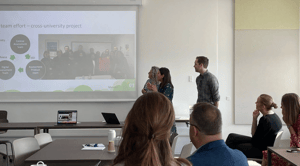
On Thursday 25 May, we hosted our first Partner Day at the Danish School of Media and Journalism. 

We were delighted to be able to welcome three of our key development partners in person, with the Norwegian Agency for Shared Services in Education and Research (SIKT), University College London (UCL) and BI Norwegian Business School all joining us, along with the European Patent Office (EPO) and the Open University (OU) joining remotely for some sessions. This group are active and vested partners in the development of WISEflow, feeding into development work that sits under the themes (seen at Sycamore ) that we are focussing on.

After introductions, the day began with a UNIwise strategy update led by our founders, Rasmus and Steffen, who discussed where UNIwise is heading in the years to come, as a company, and where WISEflow is heading, as a product.


Later in the day, the discussions centred on three interrelated topics:

  • The UNIwise Product Board and changes to release frequencies and schedules
  • The WISEflow development roadmap and SYCAmore
  • Research themes
Partner Day at UNIwise

Tina Szczepanski, Head of Research and Solutions, laid out some of the anticipated benefits that partners would see as a result of our new release structure. Changes in release cycles will ensure more reliable, earlier release communications, alongside guaranteeing more time for internal polishing. This supports our partners’ desire for more frequent, transparent and formal communication with UNIwise to collaborate and shape dialogue.

A tour of SYCAmore by our Chief Product Architect, Mads, who showcased the themes and the features that are currently being worked on, precipitated a discussion about the process of how partner needs, and wider needs in general, make their way into the release of a feature. At UNIwise, we take a thematic approach to WISEflow’s development, and partners were keen to be involved in theme analysis.

Discussions about research themes explored potential features and ideas, showcasing a longer-term perspective for WISEflow. Our key drivers for undertaking research themes are ‘data driven,’ ‘strategy driven’ and ‘contemporary tuning.’ Research so far has been focused on participants and their actions within WISEflow, for example, through outlier detection to identify participants whose behaviour falls outside the norm. Our research work on similarity has focussed on overcoming challenges such as cross-language similarities and quickly searching large web databases, which partners were very enthusiastic about.

As the day began to draw to a close, UNIwise stimulated a discussion amongst partner organisations on the subject of a few topics that we see as destined to evolve rapidly over the next few years. Each partner gave their perspective on the likely direction of travel, threats, opportunities and possible scenarios that may arise from:

  • The attention to assessment-related academic integrity and the proctoring lever that some pull

  • The future balance of summative and formative assessment, and

  • All that is AI – the knee-jerk response to ChatGPT is a return to campus, which has wider implications, such as providing power and hardware for large cohorts of students

All agreed that both the pandemic and AI have necessitated a reshaping and redesign of assessment, which is something we at UNIwise have been talking about for years, and that institutions are now facing the consequences of not having done more to rethink assessment design. These problems, the group agreed, cannot be solved by building walls around students or thinking that prohibition will sufficiently and totally address academic integrity issues.

USING DATA ANALYTICS IN HE TO SUPPORT STUDENTS

It was valuable and insightful to get our partners’ perspectives on these issues, as they are likely to shape the higher-education sector in the near future. By understanding partner organisations’ views and concerns, UNIwise can be better placed to collaborate with them and support them in the future.

In all, the pilot partnership seminar was a successful day full of meaningful insights and valuable collaboration. UNIwise thanks SIKT, UCL, BI, the EPO and the OU for joining us in Aarhus, and for their enthusiasm for more frequent and formalised partnership meetings. We look forward to future cooperation.

Sign up to our Newsletter

STAY UPDATED ON THE LATEST DEVELOPMENTS

FREQUENTLY ASKED QUESTIONS

What was the purpose of UNIwise’s first Partner Day?

The Partner Day was created to strengthen collaboration with key development partners, share UNIwise’s strategic direction, and gather input on WISEflow’s roadmap, release cycles, and research priorities.

Which institutions participated in the Partner Day?

Partners attending in person included SIKT, University College London (UCL), and BI Norwegian Business School. The European Patent Office (EPO) and the Open University (OU) joined remotely for selected sessions.

What topics were discussed during the event?

Discussions focused on the UNIwise Product Board, upcoming changes in release frequency, the WISEflow development roadmap, SYCAmore themes, and long‑term research initiatives such as outlier detection and similarity analysis.

Why are changes to WISEflow’s release cycles important for partners?

The updated release structure ensures more reliable scheduling, earlier communication, and better internal polishing, enabling partners to plan ahead and collaborate more effectively with UNIwise.

What future challenges and trends were explored during the Partner Day?

Partners shared perspectives on evolving issues such as academic integrity, the balance between summative and formative assessment, and the impact of AI tools like ChatGPT on teaching, assessment design, and campus infrastructure.

What were the main takeaways from the Partner Day?

Participants agreed that both AI and the pandemic have reshaped assessment expectations. The event highlighted the need for redesigned assessment practices, stronger collaboration, and more frequent partner engagement to shape WISEflow’s future.

RELATED ARTICLES