
Onboarding is not an installation: why the right vendor matters as much as the right platform
Great software does not guarantee success. Why onboarding is a change process, and what a vendor committed to your long-term success does differently.
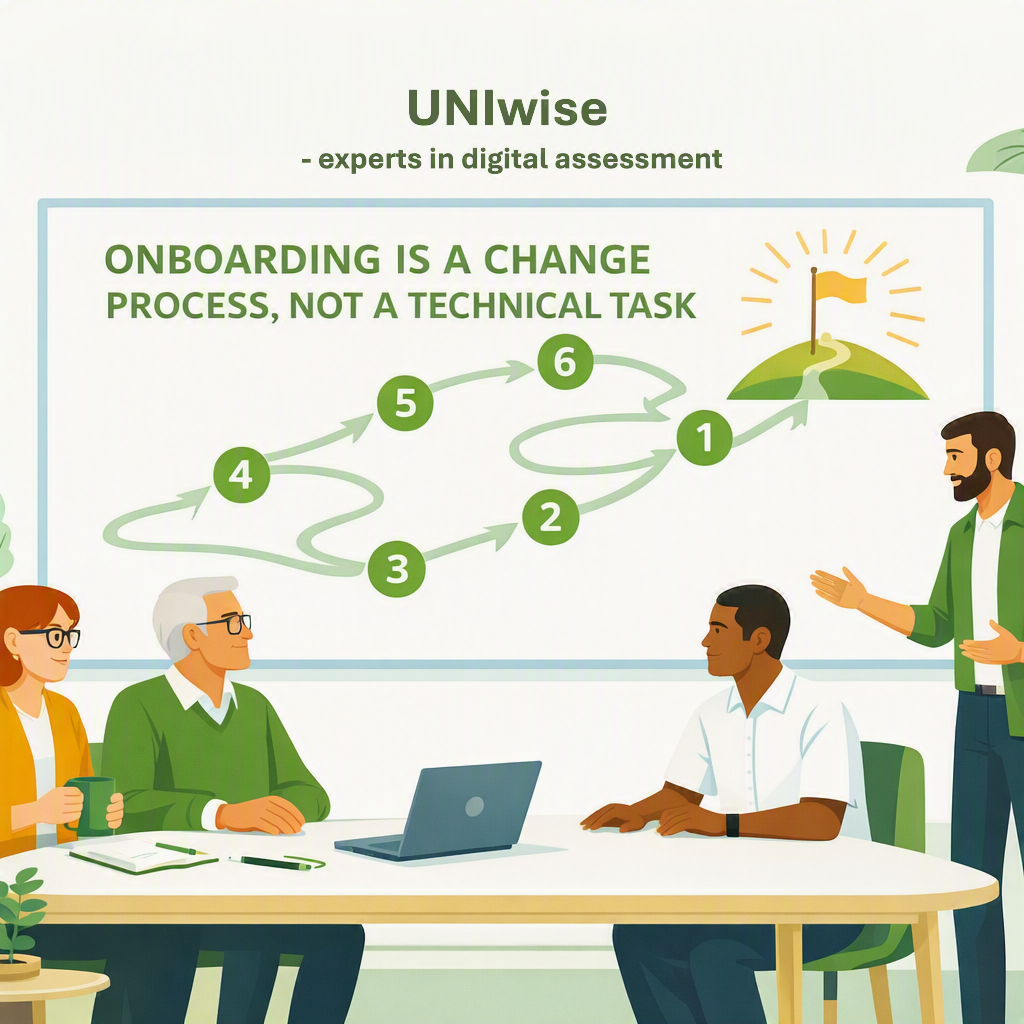
No institution buys an assessment platform because it wants more software. It buys a platform because it wants something to change: fairer and more secure exams, saner workflows in the exam office, richer feedback for students, less friction for academics. The software is the instrument. The change is the point.
That is why the most revealing question you can ask a vendor - any vendor, including us - is not “what can the platform do?” but “what will you do to make us succeed?” The two questions get very different answers, and in my experience the second one predicts the outcome of a procurement far better than the first.
The comfortable fiction of the standard implementation
A standard implementation assumes a standard institution. There is no such thing. Every institution arrives with its own regulations, its own assessment traditions, its own academic calendar, its own systems landscape, and its own history of change projects - some of them still remembered with a shudder.
Yet much of our industry still treats onboarding as a technical delivery: insert the proverbial disk, run the setup wizard, hand over the manual, close the project. The software gets installed. The institution does not get transformed. And when the playbook is identical for every customer, it is the customer who ends up bending to the tool, rather than the tool serving the institution.
The gap between those two outcomes - software installed versus institution succeeding - is exactly where onboarding lives. It is the same lesson we have drawn elsewhere on this blog: secure exams are not a feature you switch on, and neither is a successful implementation.
Onboarding is a change process, not a technical task
Look closely at what actually changes when an institution adopts digital assessment, and very little of it is technical. Exam officers build new routines for planning and running assessments. Academics change how they author, mark, and give feedback. IT integrates a new platform into the student information system and the wider architecture. Invigilators, administrators, and students all meet new ways of working - often in the most high-stakes moments of the academic year.
In other words: onboarding is the deliberate launching of new habits and practices, and the respectful retiring of old ones. It is also where the gains get harvested - better feedback quality, more consistent marking, cleaner data, faster processes. None of that arrives automatically with a login. It has to be worked for, together.
That is why good onboarding looks less like a deployment checklist and more like a supported change process: mapping stakeholders, aligning goals, training people in their actual roles, testing against real scenarios, and building confidence before the first live exam - not after it.
A vendor that adapts to your world - not the other way around
So what should you look for in a vendor, beyond the feature list?
Look for a partner who starts by listening: who maps your existing processes before proposing new ones, and who adapts the plan to your regulations, your timeline, and your people. Look for genuine sector understanding - assessment in higher education is not a generic workflow, and a vendor who has it in their DNA will anticipate problems a generalist will not even recognise. And look for how success is measured: by their delivery milestones, or by your outcomes - adoption, confidence, and quality - long after go-live.
Structure still matters. A proven process is what makes adaptation safe rather than improvised. The distinction is between a vendor who is structured but rigid, and one who is structured and responsive. You want the latter.
The long run: partnership, not project
Assessment is critical infrastructure. Once your exams run on a platform, you are not buying a product; you are entering a relationship that will span many years, many exam seasons, and many changes in both your institution and the technology around it - AI being only the most obvious example.
That changes what onboarding is for. It is not the final phase of a sales process; it is the first phase of a partnership, and it sets the tone for everything that follows. A vendor playing the long game invests disproportionately in those first months, because they know trust is built when the stakes are highest. They keep showing up afterwards too - with check-ins, webinars, product updates, and a genuine channel for your needs to shape the roadmap. And when the regulatory ground shifts, as it is doing right now with the EU AI Act, a real partner helps you get ahead of it rather than leaving you to read the legislation alone.
If a vendor treats go-live as the finish line, you have learned something important about the next ten years.
How we onboard at UNIwise
This philosophy is not abstract for us; it is codified in how we work. Every new institution is guided through six phases, each with a clear purpose.
It starts with Initiate, where a dedicated Implementation Consultant works with your team to align on goals, map existing processes, and set a clear project plan with the right stakeholders around the table - from IT to academic leadership. In Execute, we configure WISEflow to match the way you work, including integrations with your student information system and institution-specific workflows. Then comes Test & Train: structured testing in your environment and tailored training for administrators, academics, IT staff, and key users - because we do not go live until you are confident.
After launch, Hypercare gives you elevated, hands-on attention in the weeks when it matters most, with close monitoring and rapid response. From there, Support means a dedicated Customer Success team, professional support, and our comprehensive Service Centre. And finally, Continue to Improve: regular check-ins, webinars, and product update sessions, because onboarding is the beginning, not the end.
The approach works, and we can put numbers on it: a 98% onboarding success rate, more than 20 institutions successfully onboarded in 2025 alone, and an average time to go-live of under three months. Today 150 institutions across 14 countries work with us, and in 2025 WISEflow carried 4.1 million exams and assessments.
Why so many customers praise our onboarding
I could describe the effect of all this myself, but our customers say it better.
“The transition was intense and had to happen quickly, but UNIwise stayed very close to us throughout. The onboarding was thorough, and the continuous follow-up made us confident that we would succeed. This was not a standard delivery. It felt like a true collaboration.”
- Heidi Olsen, Examination administration, VID Specialized University
“For us, it’s a success story. The quality of the product was important, but the quality of the service was what really convinced us. We couldn’t have done it without UNIwise.”
- Jonas Debrulle, Director of Programmes, IÈSEG
“We dared to run large, high-stakes exams very early because we knew we had UNIwise’s support behind us. We knew they were available, we had their mobile numbers, and that made all the difference. It made us feel safe.”
- Lena Knudsen, Senior Advisor, Section for Examinations, Østfold University College
Notice what these quotes are about. Not features. They are about feeling seen, feeling safe, and being met as a partner rather than administered as an account. That - not the software alone - is what a successful onboarding produces.
The point
Platform and partner are two halves of the same decision. The platform determines what is possible; the partner determines what actually happens. Onboarding is where you find out which vendor you chose - the one running a standard implementation, or the one committed to your success for the long run.
Choose the one who understands that onboarding is more than inserting the disk.
We are here to help
Whether you are just starting with digital assessment or want to get more out of it, we are happy to share how other institutions run it in practice. Please reach out or request a demo.