Assist, don't dictate: where AI belongs in assessment - and where it doesn't
Where AI belongs in assessment today, and why assisting rather than dictating is the responsible approach for fairness, compliance and trust.
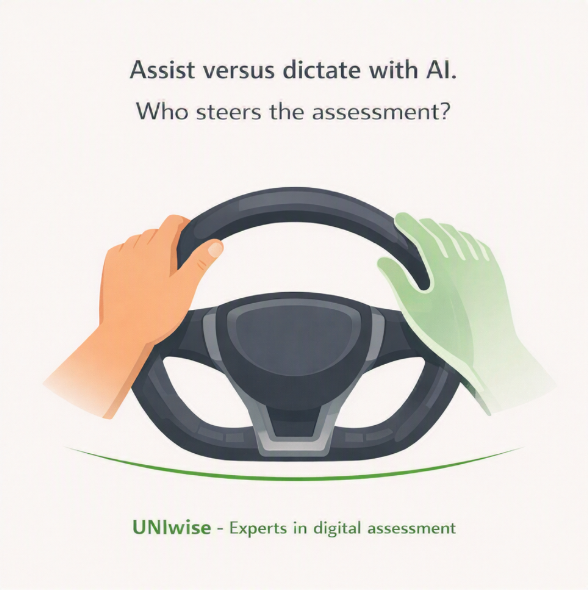
There is a line running through every conversation about AI in higher education, and most of the disagreement comes from not naming it: is the AI assisting the human, or is it driving?
It is an easy distinction to blur, because the same technology can do both. The same model that helps a marker sharpen their feedback can, with a different switch flipped, be asked to produce the grade itself. The interface looks identical. The implications could not be more different.
I want to work through the general question first - because it is the general question that should drive the answer - and only then explain the choice we have made at UNIwise, and why.
Assist or dictate - the distinction that matters
Assisting means the AI supports a person who remains in control. It drafts, suggests, checks, flags, and structures - but a human reads it, judges it, and owns the decision. The accountability stays where it has always been.
Dictating means the AI makes the call. It scores the script, ranks the candidate, decides the outcome - and the human, if they are still in the loop at all, is reduced to rubber-stamping a result they did not reach themselves.
Both are technically possible today. The interesting question is not “can we?” but “should we, here, now?” And the honest answer is that it depends entirely on where in the assessment process you are standing. Supporting an academic’s workflow is one thing. Letting a model determine a student’s result is another thing altogether - and we should not pretend they sit on the same footing.
Marking is where it gets hardest
Nowhere is this clearer than in marking. This is the part of assessment where the stakes  for the individual student are highest, where fairness is most scrutinised, and where the consequences of getting it wrong are hardest to undo.
It is also where the pressure on markers is most acute. We know markers want help, and for good reason: they face large volumes of scripts to assess in a short window, often on top of teaching, supervision and research. That is a genuinely hard set of conditions, and it is precisely why so many have started reaching for whatever tool is closest to hand - increasingly a general-purpose chatbot such as ChatGPT. The instinct is human and the need is real.
The problem is what happens next. Pasting student work into a general-purpose chatbot often sends personal data outside the EU, hands it to systems that may train on it, and quietly compromises both the privacy and the intellectual property of the students whose work it is. The student never agreed to that. The institution rarely knows it is happening. It is a data-protection and IP problem wearing the costume of a productivity gain - which is why the answer cannot simply be “stop using AI”. The need is real, so the responsible move is to give markers help they can actually trust.
Why letting AI drive is premature
If the need is real, why not let the AI go further and take on the marking itself? Because we are still early, and several things have to mature first.
There is genuine and reasonable doubt across the sector, limited experience to draw on, and trust that has not yet been earned. On top of that sit real legal uncertainties: it is still unclear where a student stands, in law, when a grade has been produced with AI involvement — their right to a fair, explainable and contestable assessment is not yet settled ground. That uncertainty alone makes AI-led grading immature today.
The regulatory picture points the same way. Some providers offer systems that participate in or influence the assessment of students without meeting - or while actively side-stepping - the obligations the EU AI Act places on high-risk AI in education: transparency, human oversight, logging, and impact assessment. A tool that helps decide a student’s result is not a low-stakes convenience, and a tool that ignores those duties is a liability an institution inherits the moment it switches it on.
There is a design dimension too. Even where AI only assists, it has to be built to work in closed circles - with access to the relevant assessment criteria, the assignment and the student’s own submission, and nothing beyond. Kept inside that boundary, it stays anchored to the task. Allowed to roam, it starts borrowing from other sources and becomes far more prone to hallucinate. Without that discipline, “assistance” quietly becomes another integrity risk rather than a safeguard against one.
The upside is real - and it will grow
None of this is an argument against AI in assessment. It would be a mistake to read caution as reluctance.
Used as an assistant, AI offers real and substantial gains - and feedback is where they show up most clearly today. It can help ensure consistency, so that the first script of the day and the last are held to the same standard. It can raise the quality and depth of feedback, giving students more than a mark and a sparse comment. It can help guard against the bias and fatigue that affect every human marker. And it can anchor feedback explicitly to the assessment criteria, turning it into something a student can actually learn from rather than a verdict they simply receive.
And the role will grow. Humans are not perfect markers either - fatigue, drift and inconsistency are real, and pretending otherwise helps no one. There will come a point when AI can responsibly assist in grading itself, not only in feedback, and as the evidence, the law and the sector’s experience mature, we should widen its role deliberately. The goal is not to keep AI permanently at arm’s length. It is to avoid throwing credibility out with the bathwater by moving faster than trust allows.
Why we’ve chosen to assist - for now
That is the reasoning behind the line we have drawn at UNIwise, and it is why our AI assistant in WISEflow does what it does, and not more.
It assists with feedback, and it does so after the marking and the grade have been decided - never before or alongside them - so it cannot influence the result it is meant to support. The human marker stays in control of the decision and owns it. The AI works in a closed circle, drawing only on the assessment criteria, the assignment and the student’s own submission. When it is active, it is visible and traceable to everyone involved - institution, marker and candidate alike. It is also explainable: how the AI works and what it drew on to reach a suggestion can be surfaced and understood, rather than left as a black box - which is not only good practice but a requirement the EU AI Act places on high-risk AI in education. And all of it runs on EU-hosted, GDPR-aligned infrastructure with a defensible audit trail, so that supporting the marker never comes at the cost of the student’s privacy or intellectual property.
We will keep widening what our AI assists with as the evidence, the law and the sector’s experience mature. But we will not get ahead of the trust that makes assessment legitimate in the first place. That is what “assist” means to us in practice - not a limitation we apologise for, but a standard we have chosen.
The point
The assist-or-dictate question will not stay still. As experience grows and trust is earned, the line will move, and some things that feel premature today will become responsible tomorrow. That is fine. What matters is that institutions move that line deliberately, with evidence and oversight - rather than having it moved for them by whichever tool a busy marker happened to open on a Friday afternoon.
For now, we are clear about where we stand. We assist. We keep the human in control. And we make sure the institution can show exactly how and why every assessment decision was made.
We are here to help
Whether you are just starting with digital assessment or want to get more out of it, we are happy to share how other institutions run it in practice. Please reach out or request a demo.

Frequently asked questions
AI is best used as an assistant, supporting human decision-making rather than replacing it. It can help structure feedback, ensure consistency, and reduce workload, while the human marker retains control and accountability.
Assisting means the AI suggests or supports, but a human makes the final decision. Dictating means the AI determines outcomes, such as grades, with minimal human oversight. The distinction is critical for fairness, trust, and accountability.
There are still unresolved concerns around trust, legal rights, fairness, and transparency. Regulations like the EU AI Act require strong oversight, and the sector has not yet built enough experience or safeguards to fully rely on AI for grading decisions.
Using tools like chatbots can expose student data to external systems, potentially outside the EU, raising GDPR and intellectual property concerns. These tools are not designed for compliant, secure academic assessment workflows.
AI can enhance feedback quality, ensure consistency across scripts, and help reduce bias and fatigue. When used correctly, it strengthens assessment by supporting markers rather than influencing grading decisions.
A responsible approach ensures AI operates within strict boundaries: using only relevant materials (criteria, assignment, submission), staying transparent and explainable, and running on compliant, secure infrastructure with full auditability.