
Change in assessment rarely fails at the top. It stalls in the middle.
Assessment change stalls with the mid-level leaders who carry it. Five things to get right when you switch platform, and what to expect from a supplier.
Most universities I talk to are not short of ambition when it comes to assessment. They want more varied formats, better feedback and a credible answer to AI. What they are short of is the capacity to turn that ambition into everyday practice.
A new report from Advance HE and Wonkhe, Developing mid-level leadership to build capacity for strategic change, puts numbers on that gap. 96% of the mid-level leaders surveyed said managing the impact of change matters. Only 14% thought their institution does it well. Introducing digital assessment is exactly this kind of change, so it is worth asking what institutions should think about, and what they should expect from their supplier.
The people who make change work are often the last to be asked
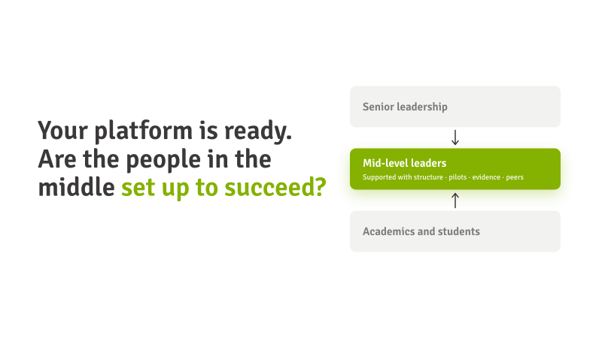
In assessment, the mid-level leaders are the heads of exams, digital education leads and programme coordinators who actually have to make a new platform work. They are held responsible for change they do not fully control, and they lead through influence rather than authority, usually without a budget or line management to fall back on. One participant described it as being “in the middle getting heat from both sides”.
The report is clear that this is not a skills problem. Most of these leaders trust their own abilities, but not the machinery around them. A new assessment platform touches every academic, student and several departments at once, so that machinery matters. The authors call it change infrastructure: clear governance, sensible sequencing of initiatives, recognition for the people doing the work, and involving those who will deliver a change while it is still being designed.
Five things to get right when you implement or switch assessment platform
Whether you are moving from paper to digital, or replacing the digital assessment system you already have, the same five things decide whether it lands.
1. Design it with the people who will run it
One senior leader in the report calls it being “critical by design”: the people who will operate a change should help shape it, not just receive it once decisions are made. Bring the exam office, IT, academics and students to the table from the start. They know where the real difficulties are, and they will spot what will not work long before go-live.
2. Decide what you will stop doing
Initiative overload is one of the report’s recurring themes. A new platform will not land well if it simply arrives on top of everything else. Be explicit about what it replaces, whether spreadsheets, paper workflows, parallel systems or the old platform itself, and plan when the old way stops. Giving people permission to stop is one of the most useful things a leader can do.
3. Start bounded, then scale
Leaders felt most confident about change they could see the edges of. Whether it is a first implementation or a switch, start with a pilot in a few programmes, agree in advance what success looks like, and scale once it works. A pilot reduces risk, and it gives you local champions who can speak to colleagues from their own experience.
4. Frame it as improvement
“Change” tends to feel like something done to people. “Enhancement” gives them agency. Talk about what gets better: clearer feedback, less manual administration, more consistent marking. That matters even more with AI, where trust has to be earned, as I argued in Assist, don’t dictate.
5. Build the evidence, and don’t rely on one person
Institutions are good at launching initiatives and less good at closing the loop. The report notes that failures are remembered while successes rarely reach the institution’s story. Decide early what you will measure, collect it, and share it, including what did not work. Evidence is what turns a pilot into a decision, and what builds trust in the next change. Anchor the work in a network across faculties and professional services too, so it survives when a sponsor moves on. Our post on assessment readiness explains why progress is rarely even across an institution.
What you should expect from a supplier
If the gap is capacity rather than technology, your supplier is either part of the answer or part of the problem. One that only brings features adds to the load. One that brings structure, experience and support takes some of it away.
A good supplier should also help you build the evidence. Mid-level leaders need more than enthusiasm to win over colleagues and senior management. They need to show what a pilot achieved: what academics and students experienced, what it saved, and what should be adjusted before scaling. A supplier that has supported many pilots knows what to measure and how to present it, and should take on part of that work. Fair questions to ask:
- How will you involve our exam office, IT, academics and students before the scope is fixed?
- What method, templates and communication material do you bring?
- Who do our local leaders call when there is pushback?
- How will you help us document and evaluate a pilot, so we can show what it achieved?
How we work at UNIwise
As I wrote earlier this year, onboarding is not an installation. Ours is a structured process, from initiation through testing and training to hypercare and continuous improvement. We involve the people who will use WISEflow every day, often start with a pilot, and see the relationship as a strategic partnership built on dialogue.
When a pilot ends, we often help the institution compile a summary report, or prepare one ourselves. It brings together feedback from academics and students, what worked, what needs adjusting, and a recommendation for next steps. We did this with UiT The Arctic University of Norway on AI-assisted feedback, documenting a first pilot, a pilot in two master’s courses and a second, formative pilot. Together, the reports gave the institution a shared evidence base for deciding how to proceed. For the leaders who must take the next step, that documentation often makes the difference.
Through our user community and partner events, we also bring institutions together to learn from each other, often without us needing to be part of the conversation. Too many are solving the same problems alone.
The bigger point
Higher education is under pressure from finances, regulation and AI that is changing assessment “not in academic years, but in months”. Much of the energy goes into reactive change, but the sector also needs change that makes assessment fairer and more meaningful for students.
That kind of change is carried by the people in the middle. Give them structure, support, evidence and recognition, and they will deliver it. Without that, even the best platform stays a good idea that never quite landed.
A simple takeaway
Technology rarely holds digital assessment back. Capacity does. Involve the people who will deliver the change, start bounded, build the evidence, and choose a supplier that helps carry the load.
We are here to help
Whether you are just starting with digital assessment or want to get more out of it, we are happy to share how other institutions run it in practice. Please reach out or request a demo.

Frequently asked questions
Usually not for lack of ambition or technology, but for lack of capacity in the middle of the institution. In the Advance HE and Wonkhe report, 96% of mid-level leaders said managing the impact of change matters, yet only 14% thought their institution does it well.
They are the heads of exams, digital education leads and programme coordinators who have to make a new platform work in practice. They are held responsible for change they do not fully control, and they usually lead through influence rather than budget or line management.
Five things: design the change with the people who will run it, decide what the new platform replaces, start with a bounded pilot before scaling, frame the change as an improvement, and build evidence in a network that does not depend on one person.
A pilot gives the change visible edges, which is where leaders feel most confident. It reduces risk, produces local champions who can speak from their own experience, and creates the evidence that turns a trial into a decision.
Structure, experience and support that take load off the institution rather than adding features to it. A good supplier also helps document and evaluate a pilot, so local leaders can show colleagues and senior management what it achieved.
Onboarding follows a structured process from initiation through testing and training to hypercare and continuous improvement, often starting with a pilot. After a pilot, UNIwise often helps compile or prepares a summary report with feedback from academics and students, what worked, what needs adjusting and a recommendation for next steps.