
Accommodations are no longer the exception. They are everyday exam operations.
Disability adjustments often fail in the handover, not the decision. Why exam accommodations should run as everyday operations, with a record you can show.
Wonkhe has just launched a new series asking what it will take for UK universities to meet the Office for Students’ coming expectations on disability inclusion. The opening piece by Mack Marshall makes uncomfortable reading. Nearly one in five students now declare a disability to their university. Yet only 44% of disabled students say that all of their agreed adjustments were actually put in place, and 39% have considered dropping out, compared with 22% of their non-disabled peers.
What struck me most was not the numbers. It was the diagnosis. The problem, the article argues, is not staff goodwill. It lies in the policies and processes that turn a support plan into practice – and in day-to-day teaching and assessment design. Anyone who has worked close to an exams office will recognise that.
This is not only a UK story. Across the Nordic countries, Ireland and Germany we see the same curve: more students with a documented need for adjustments, more applications for adapted exams, and support teams asked to do more with the same resources. So the question is no longer whether institutions support accommodations. It is whether they can deliver them reliably, at scale – and show that they did.
From goodwill to measurement
In February, the Office for Students announced that it will publish a principles-based statement of expectations on disability, and monitor impact both across the sector and at individual institutions. That changes the conversation. Until now, a lot has rested on good intentions and voluntary commitments. Once a regulator starts measuring, it is not enough to show that an adjustment was agreed. You need to show that it was delivered.
On the continent, the pressure takes a different form but points the same way. Public universities fall under the EU Web Accessibility Directive, which requires their websites and apps to be accessible and uses the European standard EN 301 549 as the yardstick. A new version of that standard, published in September 2026, raises the bar to WCAG 2.2 – the international guidelines for accessible digital content. It will find its way into tender requirements quickly. Underneath it all sits the UN Convention on the Rights of Persons with Disabilities, which commits countries to reasonable accommodation in education. As we have argued before, compliance isn’t red tape – it is how we protect students, staff and standards.
Adjustments rarely fail in the decision. They fail in the handover.
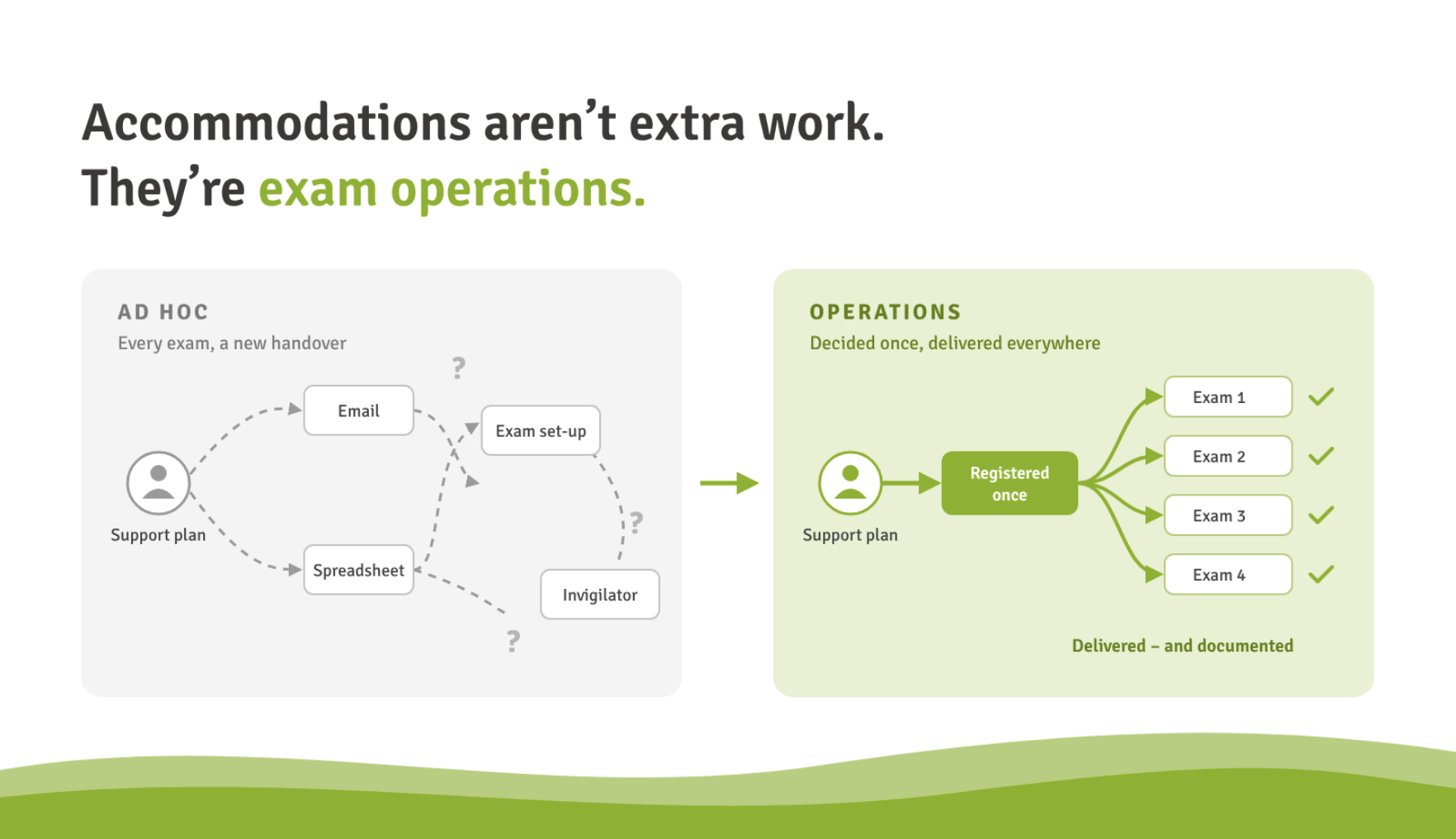
An adjustment is usually decided in one place and delivered in another. A disability adviser agrees extra time, a separate room or a screen reader. Then that decision has to travel – to the exams office, to the timetable, into each individual exam set-up, to the invigilators – often across several systems and a spreadsheet or two. Every handover is a point where it can be lost.
Multiply that by hundreds of students and dozens of exams per term, and it is hardly surprising that a promise in a support plan does not always reach the exam room. Many institutions also report that measures introduced during the pandemic, such as lecture recordings and easier extensions, are now being rolled back as budgets tighten. That is the risk when accessibility depends on extra effort: when resources fall, the ad hoc goes first. We looked at the practical side of this in Rethinking special arrangements in HE assessment.
Treat accommodations as operations, not projects
My view is that the only sustainable answer is to run accommodations as part of everyday exam operations – the same routines, the same system and the same quality checks as any other exam. In practice, four things matter:
1. Decide once, apply everywhere
A student’s arrangement should be registered once and carried into every relevant exam automatically, rather than re-entered by hand for each assessment. Fewer manual steps means fewer mistakes.
2. Accessibility built in, not bolted on
The platform itself should meet the accessibility standards institutions are measured against, and work with the assistive technology students already use – also in secure exams. Good universal design, where the exam is accessible to as many students as possible from the outset, reduces the number of individual cases you need to handle. Security and accessibility have to be balanced, which is why secure exams are not a feature.
3. A trail you can show
Institutions need a clear record of what was agreed and what was delivered. When a regulator, an appeals board or a student asks, the answer should be a report – not a search through inboxes.
4. Flexibility without a separate process
Some students are best served by a different format altogether. Offering an alternative exam form should not mean building a parallel process. That is part of why assessment design matters.
How we approach this in WISEflow
WISEflow was built as a dedicated assessment platform, and special arrangements are part of the core workflow rather than an add-on. Arrangements such as extra time are attached to the individual participant and handled in the same flow as everyone else’s exam, and our accessibility work follows the European standards our customers are measured against. The ambition is simple: a student with extra time should go through the same reliable process as every other student. You can read more about why this calls for a dedicated exams and assessment platform.
The bigger point
The growth in students who need accommodations is not a temporary spike. It reflects greater awareness, better diagnosis and wider participation – things the sector has worked for. The task now is to remove the barriers we create ourselves through fragile processes.
If accommodations rely on goodwill and spreadsheets, quality drops whenever pressure rises. If they are built into how exams are run, institutions can absorb the growth, stand up to measurement and give staff time back for the cases that need human judgement rather than administration.
A simple takeaway
Accommodations are no longer edge cases. Run them like operations. And choose a platform that lets you prove it.
We are here to help
Whether you are just starting with digital assessment or want to get more out of it, we are happy to share how other institutions run it in practice. Please reach out or request a demo.

Frequently asked questions
They are rarely lost in the decision. They are lost in the handover, as an agreed adjustment travels from the disability adviser to the exams office, the timetable, each exam set-up and the invigilators, often across several systems and spreadsheets. Every handover is a point where it can go missing.
According to figures cited in Wonkhe’s new series on disability inclusion, only 44% of disabled students in the UK say all of their agreed adjustments were put in place. Nearly one in five students now declare a disability, and 39% of disabled students have considered dropping out, compared with 22% of their peers.
In the UK, the Office for Students will publish a statement of expectations on disability and monitor impact across the sector and at individual institutions. In the EU, the Web Accessibility Directive and a new version of EN 301 549 raise the bar to WCAG 2.2. Institutions will need to show that adjustments were delivered, not only agreed.
It means handling them with the same routines, system and quality checks as any other exam. In practice: register an arrangement once and apply it everywhere, build accessibility into the platform, keep a record you can show, and offer alternative formats without a parallel process.
In WISEflow, special arrangements are part of the core workflow rather than an add-on. Arrangements such as extra time are attached to the individual participant and handled in the same flow as everyone else’s exam, and UNIwise’s accessibility work follows the European standards customers are measured against.