Why Consolidating Exam Infrastructure Protects Academic Freedom
Patchwork exam tools leave accountability in the gaps. Why one well-governed exam platform protects academic freedom instead of limiting it.
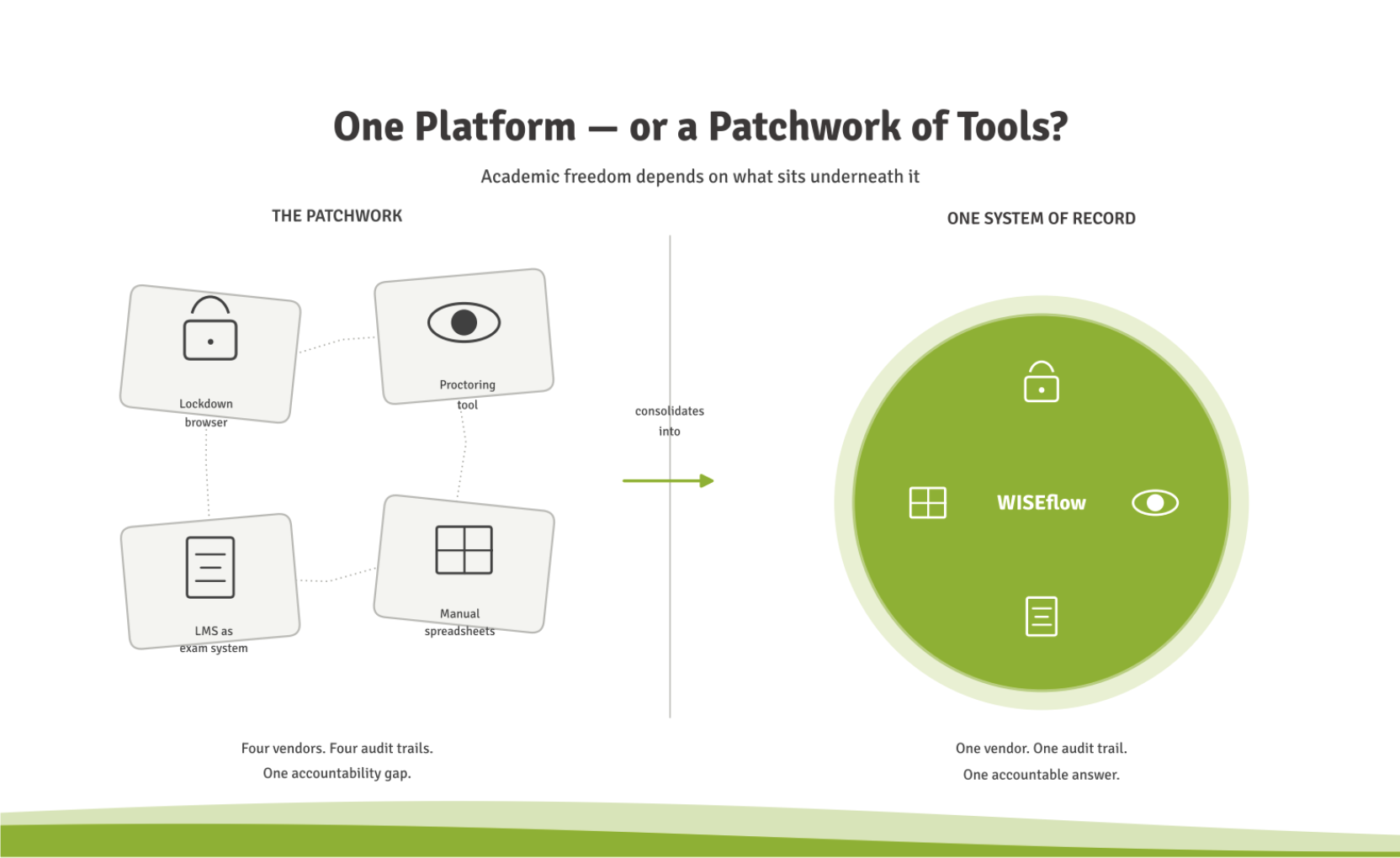
You didn’t become a registrar, an IT director, or an exams officer because you wanted to manage five vendor relationships at 11pm the night before a resit period. But that’s where a lot of institutions have ended up: a lockdown browser from one supplier, a proctoring tool from another, a learning management system doing double duty as an exam system, and a spreadsheet somewhere holding it all together. Each piece works, more or less, on its own. Together, they’re a liability nobody signed up for.
This isn’t a hypothetical. In recent weeks, we’ve spoken with a university running a formal market evaluation specifically to bring its exam delivery and live invigilation under one supplier instead of two, and with a national audit authority evaluating secure proctoring because a new line of certification exams made the gaps in their patchwork too risky to ignore. These aren’t edge cases. They’re the same decision, reached independently, by institutions that have arrived at the same conclusion: a kludge isn’t a strategy.
This post is about why that conclusion is right — and why consolidating exam infrastructure isn’t a threat to academic freedom. It’s what actually protects it.
Why is exam infrastructure different from other university IT?
Exam infrastructure is different because it has to be consistently right, for everyone, every single time — and it has to flex across an unusually wide range of disciplines and formats. A law faculty needs closed-book, high-security written exams. A design programme needs portfolio submission and multimedia review. A medical school needs practical, skills-based assessment. An economics department wants AI-assisted marking feedback layered on top of standard written answers.
One institution, often one exam period, has to support all of it — reliably, securely, and without the exams office improvising a workaround for each faculty’s edge case. That combination of academic diversity and administrative precision is rare in higher education IT. Most systems only have to be good at one thing. Exam infrastructure has to be good at all of them, at once, under pressure, with students’ futures on the line if it fails. It is also why combined and portfolio exams matter so much for diversifying assessment in the age of AI — the infrastructure underneath has to support that range from day one, not bolt it on afterwards.
Why are institutions moving away from patchwork exam systems?
Institutions are moving away from patchwork exam systems because the liability of running several disconnected tools no longer scales with what’s being asked of assessment. A generic learning platform plus a separate lockdown browser plus manual processes might get an institution through bring-your-own-device (BYOD) in-person exams — but it means every exam period leans on technical support that’s already stretched thin by staff shortages. That’s not a tooling problem anymore. It’s a resourcing problem dressed up as a tooling problem, and it’s part of the real difference between a dedicated exam platform and a standard LMS/VLE stretched to cover exams.
The same pattern shows up from the other direction too: institutions running proctoring through one vendor and exam delivery through another find that when something goes wrong — a flagged incident, a data request, a compliance audit — nobody owns the whole picture. Two systems mean two data stores, two audit trails, and two support queues to reconcile before anyone can answer a straightforward question. When that gap surfaces under a regulator’s or an auditor’s scrutiny, “we have two vendors” is not an acceptable answer.
Consolidation isn’t about cutting a line item. It’s about cutting the seams where accountability currently falls through — which is exactly why getting your assessment data back out is a governance question, not just an IT one.
Isn’t academic freedom about controlling how exams are run?
Academic freedom is about what and how you assess — not about who maintains the servers, patches the software, or keeps the audit log current. These are two different responsibilities, and conflating them is where institutions get into trouble. A faculty member should have full freedom to decide that their exam needs open-book conditions, a practical component, or AI-assisted feedback on written responses. None of that freedom depends on the registrar’s office also being responsible for IT security, data protection, and system uptime.
In fact, the opposite is usually true: a faculty’s freedom to design the right assessment is best protected when the infrastructure underneath it is stable, secure, and someone else’s job to keep that way. When exam delivery sits on a single, well-governed platform, academics get to focus on assessment design, and the institution gets a single, accountable answer when a student, a regulator, or an auditor asks how an exam’s security and its data handling can be demonstrated.
More institutions are recognising this distinction explicitly: owning the pedagogy of assessment does not mean owning its plumbing — and trying to own both, informally, through a patchwork of tools, tends to weaken both. It is the same distinction we keep coming back to: compliance isn’t red tape, it’s how institutions protect students, staff and standards in European assessment.
What does a consolidated exam platform actually protect?
A consolidated exam platform protects stability, compliance, and — ultimately — the student and the exam. When invigilation, submission, marking, and reporting live in one system, there’s one place to verify that a data request can actually be fulfilled completely, one place to confirm IT security controls are applied consistently, and one vendor accountable when something needs to change quickly, such as a new assessment format or a new compliance requirement.
It also protects students directly. A patchwork system means a student’s experience of an exam depends on which tool happens to be stitched in for their faculty, their format, their campus. A consolidated platform means every student, regardless of discipline, sits the exam on infrastructure that has been secured, tested, and governed to the same standard. That consistency is itself a form of fairness — and fairness is not a side effect of good infrastructure, it’s the point of it.
How should an institution start evaluating consolidation?
Start by mapping where liability currently sits across your existing exam tools — not where functionality sits. Most institutions can describe what each tool does. Fewer can say, clearly, who is accountable if a security incident, a data protection request, or an audit finding touches more than one of those tools at once. That gap is usually the stronger argument for consolidation internally, more persuasive than any feature comparison.
From there, the evaluation question changes from “which tool does X best” to “which platform can responsibly carry exam delivery, security, and compliance as one connected system, across every faculty we have.” That’s a different, shorter list of vendors — and it’s the list worth spending the evaluation time on.
Where WISEflow fits in
This is the problem WISEflow was built to solve: one platform that carries exam delivery, invigilation, marking, and reporting end to end, across the full range of formats a modern institution actually needs — written, oral, practical, portfolio, and AI-assisted marking support — governed to one consistent standard of security and compliance. Academic staff keep full freedom over how they assess. The institution gets one accountable system underneath that freedom, instead of a patchwork held together by goodwill and a spreadsheet.
If your exams office is currently the accountability backstop for a stitched-together stack of tools, that’s worth a conversation before your next exam period, not after an incident forces one.
We are here to help
Whether you are just starting with digital assessment or want to get more out of it, we are happy to share how other institutions run it in practice. Please reach out or request a demo.

Frequently asked questions
Running several disconnected tools, such as a lockdown browser, a separate proctoring tool and an LMS stretched to cover exams, leaves gaps in accountability. When an incident, a data request or an audit touches more than one tool, nobody owns the whole picture. Consolidation closes those gaps.
No. Academic freedom is about what and how you assess, not about who maintains the servers or keeps the audit log current. A stable, well-governed platform lets academics focus on assessment design, while the institution has one accountable answer on security and data handling.
It has to be right for every student, every time, while supporting very different formats across faculties: closed-book written exams, portfolios, practical assessment and AI-assisted marking feedback. Most systems only need to do one thing well. Exam infrastructure has to do all of them at once, under pressure.
In a patchwork setup, a student’s exam experience depends on which tool is used for their faculty, format or campus. On one platform, every student sits exams on infrastructure that is secured, tested and governed to the same standard. That consistency is a form of fairness.
Map where liability sits across your current exam tools, rather than where functionality sits. Ask who is accountable when a security incident, a data protection request or an audit finding touches several tools at once. Then look for a platform that can carry delivery, security and compliance as one connected system across every faculty.
WISEflow carries exam delivery, invigilation, marking and reporting in one platform, across written, oral, practical and portfolio formats and AI-assisted marking support. It is governed to one standard of security and compliance, and academic staff keep full freedom over how they assess.