
Norway has chosen exam design over detection. Now the sector has to build it together.
Norway's NOU 2026:14 answers generative AI with exam design, not detection. What it recommends for exams, and six areas the sector must build together.
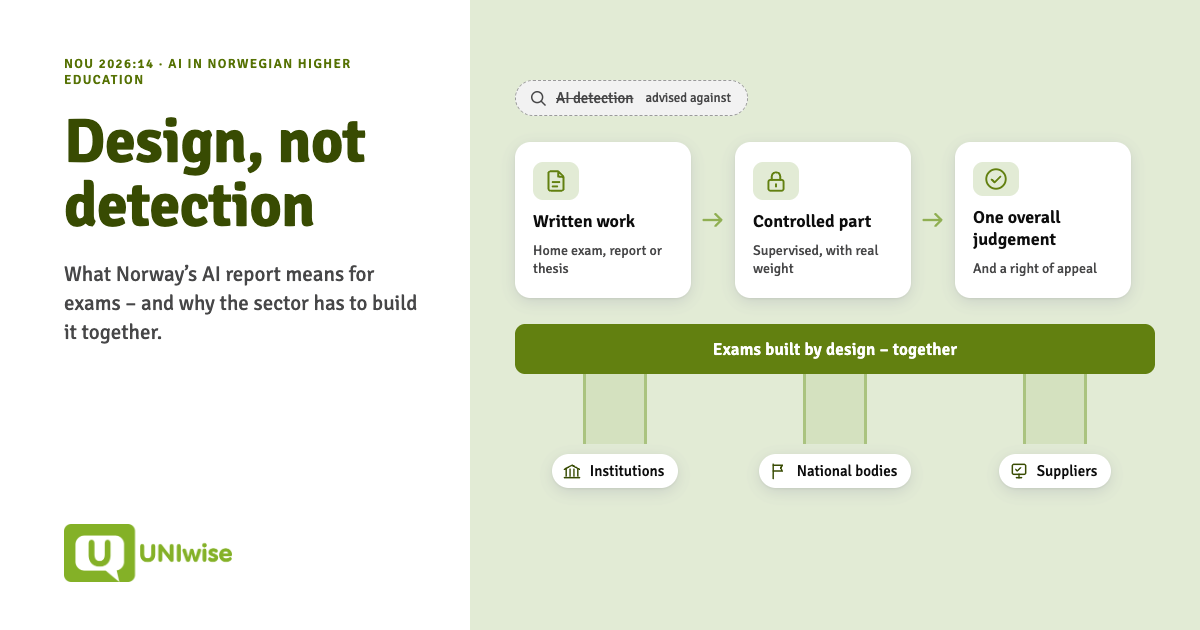
Norway’s new public report on artificial intelligence in higher education puts exams back at the centre. It answers generative AI not with more surveillance, but with assessment design – and much of what it asks for can only be delivered if institutions, national bodies and suppliers work on it together.
On 6 November 2026, a government-appointed committee chaired by Anders Malthe-Sørenssen delivered NOU 2026:14 Kunstig intelligens i høyere utdanning (Artificial intelligence in higher education) to the Norwegian Ministry of Education and Research. An NOU is an official Norwegian report: it advises the government but is not law, and a public consultation and political follow-up come next.
Even so, it deserves attention well beyond Norway. At 204 pages, it is one of the most thorough public reviews of AI and assessment in Europe so far, and institutions are already acting on it. Exam formats are usually set a year ahead, so the decisions that shape the 2027–28 exam seasons are being taken now.
The report covers a lot of ground: what students should learn about AI, how it changes teaching and learning, the competence staff need, digital infrastructure, and how the sector should govern AI systems. In this post we focus on one part of it – exams and assessment – and on what it will take to put the recommendations into practice.
What the committee found
The committee’s diagnosis is that generative AI has weakened what it calls the documentary value of unsupervised work – how far a home exam or a submitted assignment can show what a student actually knows. In 2025 only nine per cent of Norwegian students said they did not use AI in their studies at all. Yet home exams are back at roughly their 2019 level, and the committee concludes that the extensive use of home exams is no longer defensible. In the end, it warns, this affects trust in the degrees themselves.
Its answer rests on three pillars:
- More controlled exams – that is, exams taken under supervision, whether written, oral or practical.
- A controlled component with real weight added to every unsupervised exam, including master’s theses. The institution should then make one overall judgement of what the student has learned, not simply nudge the grade on the written work up or down.
- Active use of AI for formative feedback, as a supplement to the feedback teachers give.
Where the committee draws the lines
The report is unusually concrete about what it supports, what it wants tested first, and what it advises against. In simplified form:
| Endorsed | Pilot or conditional | Advised against |
|---|---|---|
|
|
|
Six areas where the sector needs to work together
Very few of these recommendations can be met by one institution, or one supplier, on its own. Taken together, they point to six areas where there is a real opportunity for the sector – and where cooperation will decide how well it goes.
1. Capacity for controlled exams
More supervised exams mean more seats, more invigilators and more devices to secure. The committee names exam venue capacity as a bottleneck and says investment in infrastructure may be needed when campus space runs out. It also asks central authorities and institutions to cooperate on exam venues for flexible and online programmes. That turns venues into a shared question rather than a local timetabling problem: regional or external venues, test centres, and secure exams on students’ own devices. Institutions can share capacity; suppliers need to make it possible to run the same exam securely across many locations at once.
2. Combination exams as the norm
A written submission followed by a controlled oral or written part is likely to become the standard pattern – which is what combination exams are. Today’s rules on appeals and re-marking make them hard to run, so the committee recommends reviewing those rules, including changing section 11-11 of the Universities and University Colleges Act. It also asks institutions to make the oral part verifiable, for example by recording it, so that students keep a real right of appeal. In practice, this means linking the parts in one process, giving one overall grade, keeping documentation of the oral part with the exam, and handling an appeal across both parts. We have written more about combined and portfolio exams and about why oral exams are as much an operational challenge as a pedagogical one.
3. Grade justifications
Norwegian students can ask for a justification of their grade. Using careful assumptions, the committee estimates that examiners spend 72,000–74,000 hours a year on this across the sector – close to 43–44 full-time equivalents. The committee itself calls this a cautious estimate, and many in the sector put the figure far higher: some institutions estimate that they alone spend 20–30 full-time equivalents a year on grade justifications, which would put the national total at several times the committee’s figure. Today the justification must come from the examiner, although AI can be used as an aid. The committee recommends trials with AI-generated justifications as a supplement, and gives a conditional recommendation for a legal basis for automating them. The condition is evidence that AI-generated justifications leave students almost as well placed to decide whether to appeal as justifications written by the examiner. That evidence will not come from one pilot. It needs comparable trials across institutions, shared ways of measuring the outcome, and suppliers able to support them.
4. Formative AI feedback
This is where the committee is most positive. Among its examples is a pilot at UiT The Arctic University of Norway, where six dentistry students in autumn 2025 received AI-assisted feedback on a written immunology assignment. The AI system, under development in the WISEflow assessment platform, was given the marking guidance, the assessment criteria and precise instructions. In the committee’s words:
“The trial showed that the tool could generate structured and largely academically relevant formative feedback when assessment criteria and clear instructions were in place.”
NOU 2026:14, Box 7.4 (our translation)
The same box notes that some of the feedback was too general or contained inaccuracies, and that academic quality assurance was needed before it was shared with students. Since that first trial, further pilots with institutions in several countries have been used to address exactly these points, making the feedback more specific and more accurate before it went into production in WISEflow in autumn 2026. Still, the real lesson stands: good AI feedback starts with clear criteria, and a teacher stays in the loop.
5. Quality assurance of marking
The committee finds the research on AI grading promising, but not yet robust enough to justify AI-supported or automated grading. In the short to medium term, it sees a different role: the examiner sets the grade, the AI flags possible deviations, and the examiner decides whether anything should change. According to the committee, this is the only substantive use of AI in grading that falls outside the high-risk category of the EU AI Act. Alongside it, the committee recommends trials where AI grades in parallel, without its grade counting, and a ban on hidden or unregulated AI use in examiner contracts. Shared trial designs, informed consent and clear rules will matter more here than any single tool.
6. A shared framework for responsible AI
The committee asks institutions to develop, together and in dialogue with central authorities, a sector-wide framework for managing AI systems. It also recommends national infrastructure for computing power and data storage, and stresses the value of running AI models on infrastructure the sector controls, to reduce dependence on single suppliers. For suppliers, the direction is clear: institutions will expect to choose the model and where it runs, that student work is never used for training, that data can be taken out again, and that Norwegian academic language works well. We have looked at the training question in more detail in Training AI on students’ work.
The hard parts
None of this comes free, and the report is honest about that.
- Cost and capacity. Controlled and combination exams cost more than home exams, and the committee expects higher education to become more resource-intensive, at least in the short term.
- Regulation with a deadline. The EU AI Act’s high-risk rules for education apply from 2 December 2027. AI used to evaluate learning outcomes in a summative setting – the grade that counts – must then meet requirements for risk management, logging, human oversight and documentation, for institutions and suppliers alike.
- Flexible and online students. The committee advises against remote supervision of digital home exams, mainly on privacy grounds, and against creating a legal basis for it. That leaves a gap for students who cannot easily come to campus – one the sector will have to fill together, through shared venues and test centres.
- No shortcut through detection. The committee finds AI detectors unsuitable for assessing learning outcomes or deciding cheating cases. They always lag behind new models, cannot separate the student’s contribution from the AI’s, flag legitimate use while missing rewritten text, and lack transparency. We reached the same conclusion in Heads we win, tails you lose.
Where UNIwise stands
We read the report as strong support for the direction we set out in our white paper From detection to verification: assessment towards 2030: moving from trying to secure the finished product to verifying what students understand. In practice, that means we will:
- support controlled digital exams at scale, including secure exams on students’ own devices and in external or decentralised venues;
- make combination exams easy to run, with written and controlled parts linked in one process in WISEflow and one overall judgement;
- build AI feedback criteria first and with a human in the loop – including AI-assisted rubric creation, which arrives in WISEflow’s December release;
- treat grade-consistency checking, where AI points out unusual grades and the examiner decides, as the responsible first step towards AI in grading;
- prepare every AI feature used in final grading for the AI Act’s high-risk rules, and keep formative and summative use clearly apart;
- stay out of AI detection, and explore short checks of understanding at hand-in – which, measured against the report, only count as a controlled component if they are taken under supervision, carry real weight and have human oversight.
Let’s work on it together
We will respond to the public consultation, and we want to work with institutions, Sikt and HK-dir on the questions no one can solve alone: venues, combination exams, evidence for AI-generated grade justifications and the terms for responsible AI in assessment. If you are planning your 2027 exams and want to compare notes, we would be glad to hear from you.
We are here to help
Whether you are just starting with digital assessment or want to get more out of it, we are happy to share how other institutions run it in practice. Please reach out or request a demo.

Frequently asked questions
NOU 2026:14 is an official Norwegian report on artificial intelligence in higher education, delivered to the Ministry of Education and Research on 6 November 2026 by a committee chaired by Anders Malthe-Sørenssen. It advises the government but is not law. A public consultation and political follow-up come next.
It recommends more controlled (supervised) exams and a controlled component with real weight on every unsupervised exam, including master's theses, followed by one overall judgement of what the student has learned. It also supports active use of AI for formative feedback, as a supplement to the feedback teachers give.
No. The committee advises against AI detectors for assessing learning outcomes or deciding cheating cases. It finds that they lag behind new models, cannot separate the student's contribution from the AI's, flag legitimate use while missing rewritten text, and lack transparency.
Not yet. The committee finds the research promising but not robust enough for AI-supported or automated grading. In the short to medium term it supports AI flagging possible grading deviations while the examiner decides, plus trials where AI grades in parallel without its grade counting.
A combination exam is a written submission followed by a controlled oral or written part, with one overall grade. The report recommends reviewing the rules on appeals and re-marking that make them hard to run, and asks institutions to make the oral part verifiable, for example by recording it, so students keep a real right of appeal.
UNIwise will support controlled digital exams at scale, make combination exams easy to run in WISEflow, build AI feedback criteria first with a human in the loop, and treat grade-consistency checking as the first step towards AI in grading. UNIwise stays out of AI detection and will respond to the public consultation.