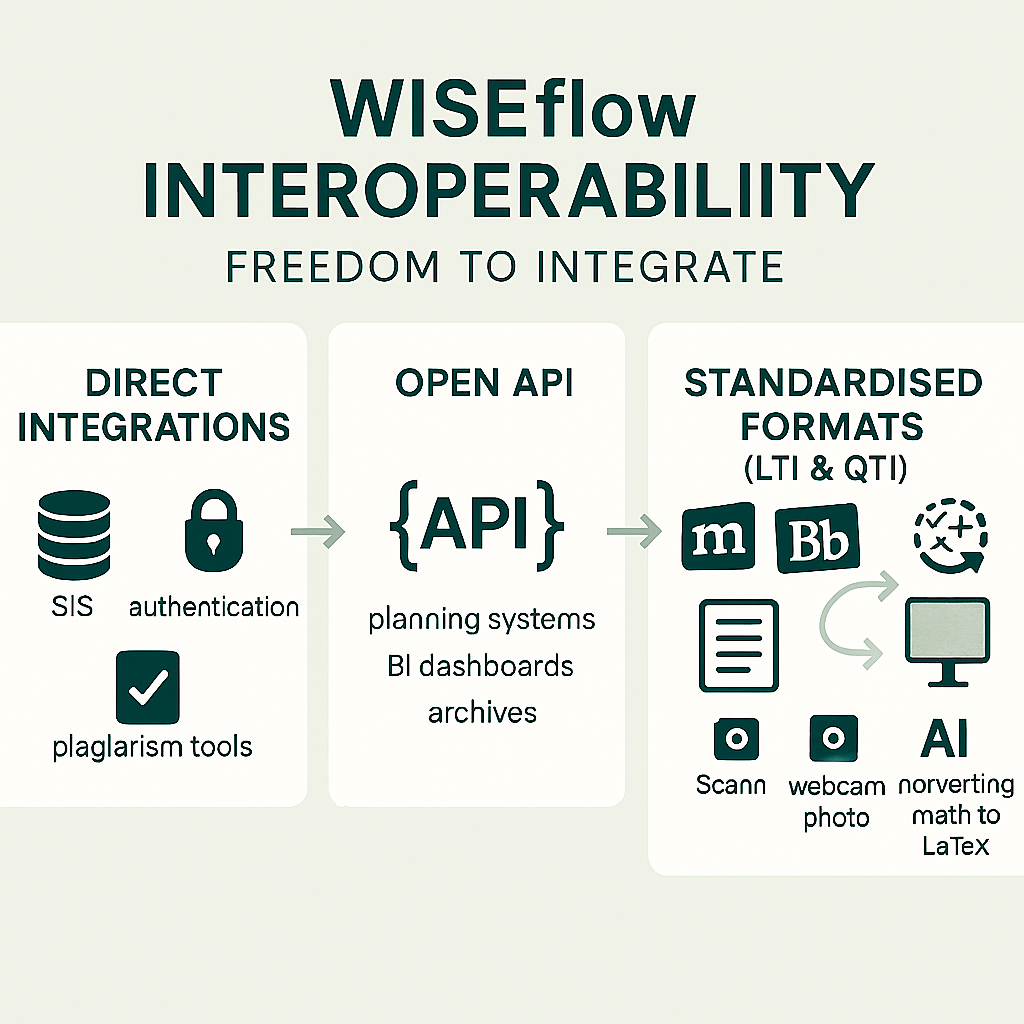
WISEflow and interoperability: empowering institutions with freedom and flexibility
When institutions choose an assessment platform, one of the most critical considerations is interoperability. The ability to integrate seamlessly with an institution’s existing IT landscape is not just a technical detail, it’s a strategic necessity. Lock-in limits flexibility, creates dependency, and can hinder innovation. At UNIwise, we believe WISEflow should fit into your ecosystem, not force you to change it. That’s why WISEflow offers multiple integration pathways, ensuring your data to flow freely and your processes remain in control.
Three dedicated integration methods
1. Direct integrations via our integration platform
For institutions that require tight coupling between WISEflow and core systems, our dedicated integration platform provides robust, secure connections. This includes:
Student information systems (SIS): synchronise enrolments and exam schedules effortlessly
Authentication services: enable single sign-on or national identity authentication for a smooth user experience
Plagiarism detection tools: integrate services like WISEflow Originality or Turnitin to maintain academic integrity
These integrations ensure WISEflow becomes a natural extension of your existing infrastructure.
2. Open API for maximum flexibility
Our open API gives institutions the freedom to innovate. Whether you need to push data into WISEflow or extract insights for other systems, the API makes it possible. Common use cases include:
Planning and resource systems: automate exam scheduling and resource allocation
Archives and compliance: export assessment data for long-term storage
Business intelligence dashboards: feed performance metrics into your analytics tools
Student portals: display exam information directly where students already engage
With the API, you’re not limited by predefined connectors, you can build exactly what your processes demand.
3. Standardised exchange formats: LTI and QTI
Standards matter for interoperability. WISEflow supports:
LTI (Learning Tools Interoperability): connect WISEflow to your LMS or VLE (e.g., Moodle, Blackboard, Canvas). This enables formative assessments within familiar environments, expanding your assessment palette beyond what the LMS alone can offer
QTI (Question and Test Interoperability): import and export questions across platforms. WISEflow supports QTI and its common variants, ensuring compatibility with systems like Moodle, Canvas, Blackboard, Brightspace and others
These standards not only simplify integration, they also future-proof your investment.
Combining methods for ultimate flexibility
Interoperability is not about choosing one method. It’s about combining them to suit your strategy. Institutions can decide:
To use their LMS as the single source of truth for student data, if no authoritative Student Information System exists, while WISEflow handles all assessment workflows
To export grades back to the LMS for consistency in reporting to students
To allow students to access WISEflow via a portal for a unified student experience
To pull student information from the SIS via direct integration, while exam dates and rooms come from planning systems through the API
To setup exams in WISEflow, but execute them in your designated math application
This mix-and-match approach ensures institutions can design an ecosystem that reflects their processes, governance, and ambitions.
Bridging paper and digital: WISEflow’s unique capability
Interoperability isn’t just about digital systems. It’s also about bridging the gap between traditional paper-based exams and modern workflows. WISEflow offers a dedicated module that keeps the entire process digital, even when paper is involved:
Scanned paper submissions: exam scripts can be scanned, automatically sorted, and distributed to markers within WISEflow
Appendix materials: students can create drawings, calculations, or diagrams on paper and submit them digitally:
Scan and upload appendices for automatic sorting
Capture images via webcam during the exam and integrate them directly into the submission
For mathematics, use our AI-powered recognition to convert handwritten equations into LaTeX for further editing
This capability ensures institutions can maintain flexibility in assessment formats while preserving a fully digital workflow for efficiency, security, and scalability.
Strategic benefits for institutions
Interoperability is more than a technical feature It’s a strategic advantage:
Freedom of choice: avoid vendor lock-in and maintain control over your data
Process alignment: integrate WISEflow in ways that complement your workflows, not disrupt them
Scalability: add new tools and services as your needs evolve, without costly re-engineering
Extended capabilities: use LTI to connect WISEflow with specialised STEM applications or other niche tools, broadening your academic reach
In short, WISEflow doesn’t just integrate, it empowers. By offering multiple pathways, we ensure institutions can design an assessment ecosystem that is flexible, future-ready, and fully aligned with their strategic goals.
Closing thought
Choosing WISEflow means choosing freedom. Freedom to integrate, freedom to innovate, and freedom to evolve. That’s interoperability done right in our opinion.
If you’d like to explore how WISEflow can fit seamlessly into your institution’s IT landscape or discuss the best integration strategy for your needs, get in touch with us today. Our team is ready to help you unlock the full potential of interoperability.