Integrations, innovations and transitions: the University of Erfurt on the advantages of digital assessment
How the University of Erfurt signed, integrated and ran its first digital exams within weeks during the 2020 lockdown.
Key takeaways
- Contract signed June 2020, first exam day 13 July
- All exams ran on their originally scheduled dates despite lockdown
- The ESE handles 300–350 master's theses a year
Background and context
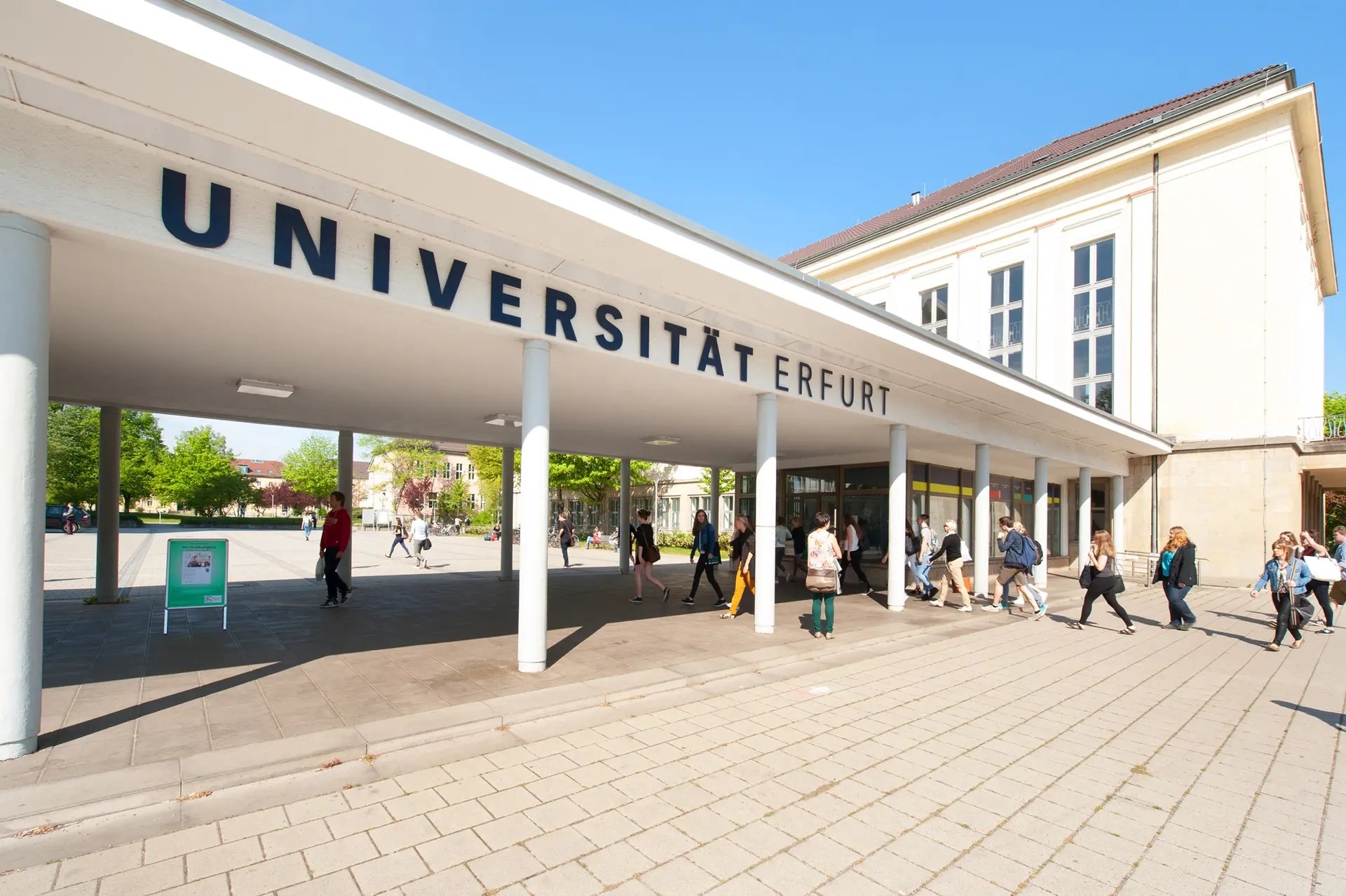
Since its new foundation in 1994, the University of Erfurt has firmly established itself in the higher education environment, both nationally and internationally, through an exceptional cultural and social science profile. With its focus on religion, humanities, cultural studies, society and teacher training, the University of Erfurt is a centrally located educational and research institution that comprisesapproximately 6,000 students, about 100 professorships, as well as about 400 academic employees and 300 administrative employees.
The University of Erfurt has been using WISEflow since 2020.
The following text is a report by Professor Dr. Gerd Mannhaupt, Vice President for Student Affairs and Director of the Erfurt School of Education at the University of Erfurt.
A catalyst for change
First of all, I would like to start out with noting that the reason for the introduction of digital exams in Erfurt was not just the result of the COVID-19 pandemic. At our university, we had been discussing the digitisation of exams already for two years before the coronavirus had emerged. Colleagues who conducted exams with many students, but had no technological support, were particularly in favor of it. Some of them mainly use multiple-choice tests, and for these exam types a digital exam is much easier to implement than a pen-and-paper exam. So, we were already looking for a solution.
Personally, I've wanted to get rid of printed, written submissions for a very long time. In the past, all students had to send me an email with one or more PDF files: Everything had to be submitted to me electronically. From my point of view, it wasn't just a matter of writing the exams digitally, but of digitizing the entire examination process. That was the decisive reason for switching, and is one of the main strengths of WISEflow! My research had shown that, apart from WISEflow, there were not a lot of suitable alternatives for us. We chose WISEflow because it is much more than simply a digital examination software for long distance exams. We liked the automatic text recognition and the anti-plagiarism services included in our license.
Decision process and privacy policy
I don't think that another open-source system will be developed that could even come close to matching the performance of WISEflow.When we first started to consider the introduction of digital exams, I asked the head of our data center, who is responsible for all IT matters: “how long would it take to develop our own examination system?" He replied that it would take at least two years. In my opinion, two years would not be enough time. These are hand-crafted systems, so if one lecturer says, "I want it to be this way," then that needs to get programmed. And then the next person comes along and says, "but I need something else." All universities that have decided to build their own systems seem to come to the conclusion that two years are not enough. No university can single-handedly develop the same features that WISEflow is offering.
It's not just a matter of time either - developing your own system requires a lot of resources. In terms of cost, WISEflow was and still is a comparatively inexpensive system. It would have been foolish for us to decide differently.
Very early in the process, we involved the State Commissioner for Data Protection („Landesbeauftragter für den Datenschutz“) as early as July 2020, before the first examination period. In the meantime, the Thuringia Higher Education Act has been amended to allow for digital exams. It now contains exactly what we need to be able to execute our undertaking in a meaningful fashion. We have adapted our examination regulations as well. These specify, for example, in which way digital exams are to be conducted. All of this is now part of the general, permanent examination policy at the University of Erfurt.
WISEflow uses AWS servers hosted in the cloud; the entire processing takes place exclusively in encrypted form. The State Commissioner for Data Protection has audited and approved the process.
From my perspective, we learn weekly of a public facility that has been compromised in some way. No one is now claiming that the location of the servers should be in Thuringia because of these breaches - you should never believe that you're secure just because the backups are stored locally, right? Surely you can build a good backup system where maybe the last day's data is uploaded before a cyber-attack, but local servers are only as secure (or insecure) as the servers that AWS runs in Ireland. So, what's the difference? I’d say, AWS servers are more secure because there is a greater expertise in security technologies there.
Adoption of the platform at the university
The implementation was relatively quick. We signed the contract in June 2020, and the first exam day was on July 13. Which means that we implemented it within eight weeks. At that point, the UNIwise staff said it was going to be a close run. One reason we managed to implement it virtually unnoticedly was that we took advantage of the Corona situation from an early point. All the colleagues from other universities that we had talked to, who had only started thinking about digital exams afterwards - when the pressure by the COVID-19 lockdowns had already tapered off - had to deal with enormous resistance from the teaching staff.
There were also universities here in Thuringia that, even during the lockdowns, tried to somehow manage everything via attendance because they hadn’t been able to convince their faculty. They didn't make sure to take the lecturers along with them on this journey.
Here at our university, on the other hand, colleagues and students asked me, "When are we going to get an electronic examination system?" The idea was met with widespread approval. The smaller programs would go along with it anyway, but what was really important was to win over advocates in the larger programs that execute written exams with 300 or 500 students.
Everything went off without a hitch and worked flawlessly. There was not a single incident in the exams during the pandemic. All our exams were written on the days that they were set out for previously in the March 2020 course catalogue. Not one exam was cancelled. So that's the result - it was good! 6,000 students here have used the system and were absolutely happy that they all would get their certificates in September 2020 and not have to wait a year or two - or even a semester - because the exams can't take place. And the students gave us a lot of credit for the fact that there were no delays. We've gotten a lot of positive feedback from them.
Bringing the employees on board
Personally, I feel very confident with the use of WISEflow. In the beginning, I attended every available training session. And by now, of course, all our employees are up to date as well. It's important to involve all the stakeholders of the project during the implementation phase to really get everyone on board. Even if itdoesn'tcorrespond tothecommonbelief, lecturers at universitiesessentiallyhaveaconservativestance.Asinnovative as their research may be, they are conservativein regard to structural questions.Everything is supposed to stay the way it is, orevenbetter, go back to the way itwasyears ago. As I said, according to our examination regulations,digital exams are thenorm. But the examiner of a master's thesis can alsocheck offinthe digital registration form thatthey wanta paper version.
In that case, studentsmustsubmitasecondversion of their thesis so that themarkingcan be done on paper.So yes,that still exists, but it isverylimited. At the Erfurt School of Education (ESE), this is not a big problem. There is alwaysonediscussion: What is the best way to correct thestudents’ submissions?In every modernworkplacethere should be at least one computerthat is designedforthe use of adigital pen, withsoftwarebetter than Acrobat, on whichsomeonecan make handwritten corrections in the PDF files.That ishow I do it. I havea specialsoftwareforthis,and it works smoothlyfor such tasks. I can read and write with it just like I do on paper.
If Ididn'thave thatoptionas alecturerand had to do all my annotation workwith a keyboard and mouse,thenIwouldn'twant to correct or edit digital examseither. But ourdatacenter has now introduceddigitalpen-enabled devices formarking, so nowmore and morelecturersare using thisoption.That'swhy there are no more reservations.
Compliance with university regulations
According to our regulations, we have to store exams and papers for five years. Thanks to WISEflow, we are now gradually getting rid of tons of paper from our shelves and metal cabinets. All papers are being moved onto WISEflow's electronic archive instead. We are literally seeing tons of paper disappear from cabinets and shelves. Now everything is neatly archived and available at any time, and according to our license agreement with UNIwise, everything is deleted after five years, just as it should be. In other words: the physical archive system belongs to the past.
This feature, which we first became aware of during the presentation of WISEflow, was the decisive factor in our selection of the platform. I didn't just want a provisional system for online exams for the time of the COVID-19 pandemic – the consideration was, and still is, that we introduce a system here once and for all and maintain it.
It is also regulated in the examination regulations that, for example for master's or final theses, the submission of the paper version is no longer the legally binding hand-in date (we don't even want a paper version anymore), but instead the date of the electronic hand-in. The deadline for the submission is the end of the flow in WISEflow.
In January 2021, several students approached the Erfurt School of Education (in short, “ESE”), which is our Center for Teacher Education and Educational Research, of which I am the director. They called us and asked if ESE knew which copy stores were open during lockdown. Then, problems arose. "How are final papers going to be printed for submission in lockdown if all the copy stores are closed?" The ESE asked me how we were going to solve that, and I said we could do it via WISEflow without any problems. You must keep in mind that by far most master’s theses are written at the ESE: 300 to 350 master theses. That means that during this examination period, there were 350 students who could not submit the printed versions because it wasn’t possible to get four copies of their thesis printed. So, we just quickly set that up digitally at the ESE.
You can't submit papers by email. That's not legally possible. If you require digital exam documents from the students, they have to be sent via WISEflow. Everyone is absolutely convinced of WISEflow’s features. All faculties are using WISEflow and all master's theses are processed through it.
Advantages of digital exams for the university of erfurt
1.One of the advantages of WISEflow as a system is that changes are relatively unproblematic to execute. You can easily extend the whole thing with an individual examination period. And another big advantage: archiving is no longer necessary. We had meters of exam papers in our archives. If you have a lot of written exams, you have a lot of paper. All that is no longer necessary.
2. Teachers can effortlessly provide students with the submissions along with their own comments. It is important to emphasize that according to a ruling of theEuropean Court of Justice, every student has the right to a copy of their work with the examiner's comments. To comply with this, all you have to do ischoose whether you want to share inline feedback with students. A simple click enables you to share that feedback easily. All in all, the efficiency of the system was simply compelling.
3. The enormous amount of time I save as a lecturer can now be used elsewhere. Grades had to be entered beforehand and checked again, then usually transferred to Excel. Such tasks have completely fallen away. Judging from my own experience, I would say that about half the reading time is being saved compared to handwritten exams. I always create essay exams, and digital papers are just much faster to read than handwritten ones. Currently we are working on making students aware that texts can also include a structure, and that they can work with headings. That is the next challenge. Otherwise, they literally write 1,000 words in a single block. There's not even a paragraph. That's just a win-win for all of the teaching staff, from a reading perspective.
4.Another advantage - cost savings. We save on infrastructure costs, say for furniture and equipment. A single exam period costs us as much as the WISEflow software for a whole year with all its accompanying customizations. We also save money because student assistants no longer have to deal with all the paper, not to mention printing costs. We used to have to print documents, exams and instructions for hundreds and thousands of students. That's all in the past. For us, the price of the system is one of the strongest arguments.